
Resource Adequacy
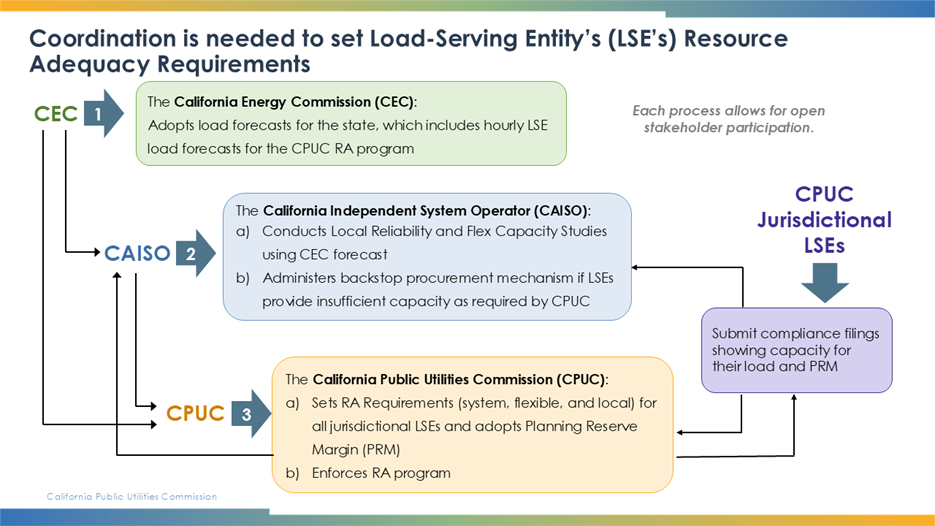
The Resource Adequacy program has two goals: 1.) to ensure the safe and reliable operation of the grid in real-time providing sufficient resources to the California Independent System Operator (CAISO) when and where needed, and 2.) to incentivize the siting and construction of new resources needed for future grid reliability.
Program Overview
The CPUC adopted a Resource Adequacy (RA) policy framework (Public Utilities Code section 380) in 2004 to in order to ensure the reliability of electric service in California. This established obligations applicable to all Load Serving Entities (LSEs) within the CPUC’s jurisdiction, including investor-owned utilities (IOUs), energy service providers (ESPs), and community choice aggregators (CCAs).
-
With the exception of the two waiver opportunities described below, the CPUC’s LSEs are required to meet RA obligations, irrespective of price, availability, or penalties.
-
The CPUC strictly enforces non-compliance with RA obligations via penalties and expects all LSEs to maintain full compliance with the RA program.
-
There is no waiver for LSEs who are unable to provide their share of System RA; failure to do so jeopardizes the reliability of all customers since insufficient electricity capacity can directly cause grid emergencies or outages.
Commission staff evaluates LSE filings annually and monthly to ensure accuracy and completeness.
We also lead annual RA proceedings to refine the RA program, the most recent of which is R.25-10-003.
Proceeding R.25-10-003
Modified Track 2 Schedule (Excluding FCR and LCR Issues)
September 15, 2026 (Hybrid) Workshop on Energy Division and party LOLE studies
- November 2, 2026 - Parties file and serve final 2028 LOLE studies and PRM proposals*
- November 20, 2026 - Opening comments on LOLE studies and PRM proposals filed and served
- December 11, 2026 - Reply comments on LOLE studies and PRM proposals filed and served
Early February 2027 Workshop on Track 2 Proposals
- February 26, 2027 - Opening comments on Track 2 proposals (other than PRM proposals) filed and served
- March 12, 2027 - Reply comments on Track 2 proposals (other than PRM proposals) filed and served
- June 2027 - Proposed Decision on Track 2
* CPUC Energy Division may submit a proposal before or concurrently with party proposals
| Types of Requirements/Products |
|
| Compliance Time Frames |
Year Ahead (YA) & Month Ahead (MA) System and Flex Requirements
Time frame
|
| Physical/Firm |
|
| Deliverability |
|
| Must Offer Obligation (MOO) |
|
The Commission’s RA policy framework, implemented as the RA program, guides resource procurement and promotes infrastructure investment by requiring that LSEs procure capacity so that capacity is available to the CAISO when and where needed.
It contains three distinct requirements:
- System RA requirements (effective June 1, 2006)
- Each LSEs CEC-adjusted forecast plus a planning reserve margin of 17% (beginning in 2024)
- Local RA requirements (effective January 1, 2007)
- Annual CAISO study using a 1-in-10 weather year and an N-1-1 contingency
- Flexible RA requirements (effective January 1, 2015)
- Annual CAISO study that currently looks at the largest three-hour ramp for each month needed to run the system reliability
2 Types of Resource Adequacy Filings
Annual
Filed on or around October 31st
- LSEs are required to make an annual System and Flexible compliance showing for the coming year.
- For the System showing, each LSEs is required to demonstrate that it has procured 90% of its System RA obligation for the five summer months of the coming compliance year.
- Additionally, each LSE must demonstrate that it meets 90% of its Flexible RA obligation for all twelve months.
- For LSEs in the San Diego local distribution area only, each LSE has a three-year forward local obligation and must meet 100% of its local requirement for the years one and two and 50% of for year three.
Monthly
Filed 45 days prior to compliance month
- LSEs must demonstrate they have procured 100% of their monthly System and Flexible RA obligation.
- Additionally, on a monthly basis from July through December, LSEs in the San Diego local distribution area must demonstrate they have met their revised (due to load migration) local obligation.
- LSEs in SCE and PGE local distribution areas are no longer required to demonstrate 100% local RA compliance as the Central Procurement Entity assumed responsibility for local in those areas as of 2023 compliance.
Annually
LSE must demonstrate procurement of 90% of System RA obligation for the five summer months of the coming compliance year.
Monthly
LSE must demonstrate procurement of 100% of their monthly System RA obligation.
Annually
For its three-year forward obligation, each LSE in the SDGE area must demonstrate procurement of 100% of Local RA obligation for each month of compliance years one and two and 50% of Local RA obligation for year three.
For LSEs in the SCE and PGE local procurement need only be demonstrated for 2022.
Monthly
From July to December, LSE must demonstrate procurement of their revised (due to load migration) Local RA obligation.
Annually
LSE must demonstrate procurement of 90% of Flexible RA obligation for each month of coming compliance year.
Monthly
LSE must demonstrate procurement of 100% of their monthly Flexible RA obligation.
Filings for ESPs and CCAs
Current RA program rules specify that LSEs and CCAs serving retail load in California submit RA filings and other information to the CEC, CAISO, and CPUC according to the schedule laid out in the current RA program guide.
This in general means that LSEs and CCAs must submit forecasts of load two months before the month of serving load, and RA Filings that specify what capacity will be used to meet their RA obligations one month before serving retail load.
ESPs and CCAs new to California must contact the CPUC and CEC to determine filing requirements and receive appropriate instructions. Please see the current year RA compliance materials for detailed instructions regarding RA filings.
For more information about new ESP registration rules and requirements click here
The Commission adopted a penalty structure for an LSE’s failure to meet its RA obligations in D.05-10-045 and D.06-06-064, and it has made a few modifications to the penalty structure since those originating decisions.
- In 2011, the CPUC modified the penalty structure of the RA program via D.11-06-022, changing both the penalties applicable under Resolution E-4195 and other program penalties. D.11-06-022 eliminated the penalty for small procurement deficiencies and instead created a Specified Violation for any procurement deficiency remedied within five business days, referred to as an administrative deficiency.
- Since 2021, the penalty structure has been expanded to include flexible RA requirements and multi-year local RA requirements.
- For deficiencies not cured within five business days, D.19-06-026 raised the local RA penalty price of $3.33/kW-month to $4.25/kW-month. In 2020, the CPUC modified the penalty structure to reflect different penalty amounts by year. The penalty structure provided in the table below was most recently revised in D.20-06-031 to include shaped system penalty prices as shown in Table 1.
Table 1. Updated RA Penalty Structure as adopted by D.20-06-031 and reflected in the 2023 Filing Guide for System, Local and Flexible Resource Adequacy (RA) Compliance Filings
| Deficiency in either System, Local or Flexible RA Filing (Modifying Appendix A in Resolution E-4195) | |||
|---|---|---|---|
| System RA Penalty | Local RA Penalty | Flexible RA Penalty | |
| Deficiency cured within five business days from the date of notification by the Energy Division | $5,000 per incident if the deficiency is 10MW or smaller, $10,000 for a deficiency larger than 10 MW. For the second and each subsequent deficiency in any calendar year, penalties will be $10,000 per incident if the deficiency is 10 MW or smaller, $20,000 for a deficiency larger than 10 MW. | $5,000 per incident if the deficiency is 10MW or smaller, $10,000 for a deficiency larger than 10 MW. For the second and each subsequent deficiency in any calendar year, penalties will be $10,000 per incident if the deficiency is 10 MW or smaller, $20,000 for a deficiency larger than 10 MW | $5,000 per incident if the deficiency is 10MW or smaller, $10,000 for a deficiency larger than 10 MW. For the second and each subsequent deficiency in any calendar year, penalties will be $10,000 per incident if the deficiency is 10 MW or smaller, $20,000 for a deficiency larger than 10 MW |
| Replaced after five business days from the date of notification or not replaced | $8.88/kW-month in summer months (May through October) and $4.44/kW-month in non-summer months (November to April) |
$4.25/kW-month
|
$3.33/kW-month |
In D.21-06-029, the Commission adopted a tiered point system that went into effect in 2022. An LSE would accrue points for each instance of a system deficiency. Accruing points would push the LSEs into higher tiers subject to penalty multipliers as shown in Tables 2 and 3
- Points shall expire 24 months after the violation.
- Accrued points within an RA compliance year shall be carried over to the next RA compliance year.
- The provider of last resort shall not accrue points for a deficiency resulting from unexpected load returns for which a system RA waiver is granted.
On June 29, 2023 the Commission adopted D.23-06-029, which is under the current RA Reform open proceeding R.21-10-002. D.23-06-029 revises the existing penalty structure and is effective beginning with the July 2023 RA filing period.
Ordering Paragraph 17 of the decision states:
"Penalty points accrued by an LSE will be applied to an LSE’s month-ahead and/or year-ahead Resource Adequacy (RA) penalties. If an LSE enters a higher tier during a year in which it incurs year-ahead deficiencies, the higher penalty will apply beginning with the monthly deficiency when the LSE enters the higher tier. The month in which an LSE accrues points that brings the LSE into the next tier, the higher penalty will apply to the deficient month for which the points were accrued."
- Penalty points accrued by an LSE will be applied to an LSE’s month-ahead and/or year-ahead Resource Adequacy (RA) penalties.
- If an LSE enters a higher tier during a year in which it incurs year-ahead deficiencies, the higher penalty will apply beginning with the monthly deficiency when the LSE enters the higher tier.
- The month in which an LSE accrues points that brings the LSE into the next tier, the higher penalty will apply to the deficient month for which the points were accrued.
In addition, D.23-06-029 Ordering Paragraph 18 adopts that:
" All year-ahead Resource Adequacy (RA) deficiencies will be charged at the Tier 1 price, and in the month-ahead RA process, the load-serving entity (LSE) will pay the difference between its month-ahead tier penalty and the Tier 1 penalty that was already paid on its year-ahead RA deficiency, plus the LSE’s current tier price on any incremental month-ahead RA deficiency."
The following formula will be applied:
- Year-Ahead penalty = Deficiency Year-Ahead x Tier 1 Price
- Month-Ahead penalty = [(Deficiency Year-Ahead x Tier 1 Price x Tier Price Month-Ahead – Year-Ahead penalty] + (Deficiency Month-Ahead incremental x Tier Price Month-Ahead)
- For further details regarding other applicable penalty rules, please consult D.19-06-026, D.20-06-031, D.21-06-029, and D.23-06-029.
Table 2. Points for System RA Deficiency as adopted by D.21-06-029 and reflected in the 2023 Filing Guide for System, Local and Flexible Resource Adequacy (RA) Compliance Filing
| Months | Points for each instance of RA Deficiency |
|---|---|
| Non-summer (November - April) | 1 |
| Summer (May - October) | 2 |
In adopting the Local RA requirement framework in D.06-06-064, the CPUC simultaneously determined a waiver process was necessary as a market power mitigation measure. Specifically, the decision allows LSEs to request relief from their local RA procurement obligation under certain conditions, although the market for Local RA is frequently a tight market.
To be considered for a Local RA waiver, an LSE must provide a demonstration that it has made every commercially reasonable effort to contract for Local RA resources.
- Pursuant to D.06-06-064, LSEs who cannot meet their local RA requirements may file a local waiver request.
- D.19-06-026 requires that the local waiver requests be filed through a Tier 2 Advice Letter.
Once a local waiver is submitted, Energy Division then evaluates the local waiver requests and issues disposition letters (posted below).
A waiver request must include both of the following:
- a demonstration that the LSE reasonably and in good faith solicited bids for its RAR capacity needs along with accompanying information about the terms and conditions of the Request for Offer or other for solicitation, and
- a demonstration that despite having actively pursued all commercially reasonable efforts to acquire the resources needed to meet the LSE's local procurement obligation, it either:
(a) receive no bids, or
(b) received no bids for an unbundled RA capacity contract of under $51 per kW-year or for a bundled capacity and energy product of under $73 per kW-year or
(c) received bids below these thresholds but such bids included what the LSE believes are unreasonable terms and/or conditions, in which case the waiver request demonstrate why such items and/or conditions are unreasonable.
An LSE's waiver request that meets these requirements is a necessary but not sufficient condition for the grant of such waiver.
The Commission will also consider other information brought to its attention regarding the reasonableness of the waiver requested.
Local Waivers Issued (disposition letters): 2022 | 2021 | 2020 | 2019 | 2018
Providers of Last Resort (POLRs) are required to continue electric energy service when a Community Choice Aggregator (CCA) fails to provide it to customers. SB-520 passed in 2019 to require the CPUC to develop a comprehensive POLR framework. To enact SB 520, the CPUC established R.21-03-011. The investor-owned utility (IOU) is currently responsible for being POLR.
In D.20-06-031 Ordering Paragraph 21, the Commission adopted a POLR waiver for limited system and flexible RA:
The provider of last resort (POLR) may be eligible for a limited system or flexible Resource Adequacy (RA) waiver for instances in which retail load is:
(a) returned to the POLR with insufficient time to meet the RA requirement, or
(b) not transferred from the POLR to another load-serving entity (LSE) as planned as a result of action or inaction by the LSE. The waiver shall be submitted through a Tier 2 Advice Letter. The POLR waiver process shall be effective immediately
Resources
- Compliance materials
- Decision history and workshop materials
- Report on Slice of Day Transactability
- Report of the Central Procurement Entity (CPE) Framework
- Report on Slice of Day Implementation and Year Ahead Showings
- Appendices for Slice of Day Implementation and Year Ahead Showings
- System Reliability Modeling (Project Documents)
Related
Contact Us
For additional Resource Adequacy compliance questions
- CPUC: RAFiling@cpuc.ca.gov
- CEC: rafiling@energy.state.ca.us