
From Grit to Governance: John Reynolds' Path to Leading the CPUC

There might not be a more challenging time to come in as President of the California Public Utilities Commission (CPUC). Balancing rising electricity rates and consumer frustration against the need for major upgrades to aging utility infrastructure, wildfire mitigation, and the state’s goal of achieving 100 percent renewable energy by 2045 is no small task. And that’s in addition to the telecommunications, railway safety, water quality, and autonomous vehicle regulation the agency also oversees.
Luckily, newly Governor-appointed President John Reynolds comes to the role with fortitude. When he graduated from the University of California-San Francisco College of Law in 2011, the legal field as well as many other occupations, had not yet recovered from the recession.
“I struggled to find work,” he says, eventually landing a job at a small insurance law firm. “I had many moments of self-doubt and that produced a lot of grit. I learned I can figure things out when there is a lot of internal and external struggle.”
He demonstrated this grit during his first week as president when he thoughtfully handled a myriad of tough questions from California legislators during an hours-long Energy Oversight Hearing. Last year as a commissioner, he led the CPUC’s proceeding for the telecommunications Carrier of Last Resort Rulemaking (COLR) and presided over more than a dozen Public Forums held virtually and in locations around the state.
“President Reynolds consistently leads with listening,” says Ana Maria Johnson, CPUC Deputy Executive Director for Communications, whose staff worked on the COLR proceeding. “I’ve watched him stay grounded in active listening and translate complex issues into thoughtful decisions that maintain a focus on the impact to the customer.”
Growing up in Salem, Oregon, President Reynolds learned the importance of perseverance and listening as a core part of public service from his mother, an environmental specialist with the Oregon Department of Transportation, and his grandmother, a teacher. After graduating from Brown University, he moved to the Bay Area for law school and one of his professors sparked his interest in utility companies. This began his thinking around the principles and structures of utility regulation and the “forensic accounting” needed to be efficient with customer dollars.
A couple of years later, he joined the CPUC. He first worked in the Legal Division, then on water rates in the Public Advocates Office, before serving as an Advisor to two commissioners. Governor Newsom appointed him as a Commissioner in 2021 and President in 2026. He has worked on a variety of issues at the CPUC, from water company consolidations to the Verizon-Frontier acquisition to the Renewables Portfolio Standard to PG&E’s General Rate Case.
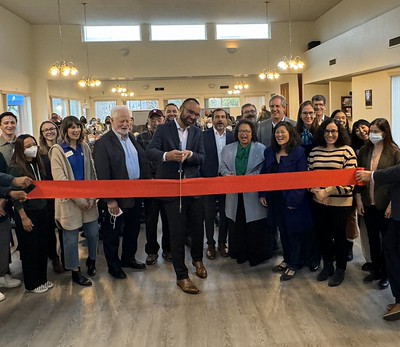
In January 2024, President Reyolds celebrated a community-driven solar project that received funding through the CPUC's Solar on Multifamily Affordable Housing program at St. Mary’s Gardens, affordable housing for seniors in Oakland.
He is especially interested in utility rates and rate-making and knows well the challenges California faces as he steps in as president.
“I’m excited about the role, knowing there are many challenges across all the sectors we regulate,” he says. “We are overseeing the electric industry during an incredibly difficult time in our history. Customer affordability is hard with wildfires, increasing energy needs on an aging grid, net-metering inequities, and our clean energy transition, which is all within a larger cost-of-living crisis in California. There’s pressure on our agency to provide balance.”
As President Reynolds noted in the Energy Oversight Hearing and during several speaking engagements as part of San Francisco Climate Week in April, wildfire costs have been a major driver of electric rate increases since 2019. Utilities have invested approximately $27 billion in wildfire mitigation and $14 billion for wildfire insurance premiums.
“Wildfire risk is not just an electricity system issue, it is a societal issue,” he says. “It encompasses climate change, land use patterns, and decades of accumulated risk across the landscape. There is an important conversation about whether it is appropriate for ratepayers alone to bear those costs or whether they should be more broadly shared.”
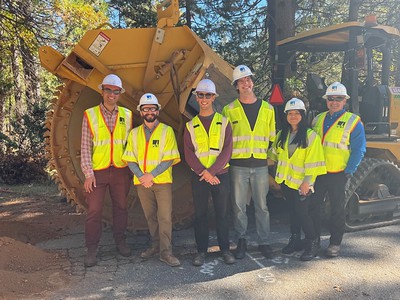
President Reynolds and CPUC staff observing a utility undergrounding project in 2025.
When President Reynolds talks about the CPUC’s overall regulation of energy rates, he reiterates that it’s important to be precise, promote equity across California communities, and plan for the future.
“Lower-income households pay a higher share of their income toward energy and that is something we take very seriously,” he says. “We scrutinize every major investment of the utilities we regulate, both before and after the fact, and we disallow costs that are now, and in the future, not justified.”
CPUC Commissioner Matt Baker says President Reynolds’ experience and knowledge uniquely positions him to tackle affordability challenges. “We’re in good hands,” Commissioner Baker says. “He is one of the most experienced people to take the helm of the CPUC.”
One of the reasons President Reynolds says he accepted the appointment is he feels the agency has built up the institutional knowledge and capacity to take on these challenges.
“We have an agency of very dedicated people who know the sectors we regulate and understand the impacts of our decisions,” he says. “They listen to the public and process vast amounts of information to make really informed decisions.”
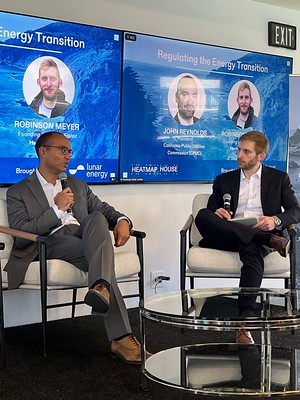
President Reynolds shares insights on California's clean energy transition with Robinson Meyer, Founding Executive Editor at Heatmap News, during an SF Climate Week event in April.
President Reynolds sees a depth of expertise and adaptability in CPUC employees, whether it’s overseeing complex modeling for utility rate cases, deploying broadband in lower-income communities, piloting new renewable fuels, adjusting water quality standards due to new contaminants, or ensuring the safety of an ever-evolving regional transportation structure. Whenever possible, he says he tries to empower employees and move decision-making to those working closer to an issue with the right checks and balances from leadership.
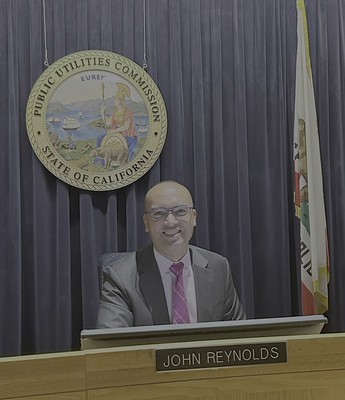 President Reynolds at the CPUC's May 14 Voting Meeting in San Francisco.
His goals as president include continuing to build internal agency capacity and expertise while communicating and sharing with stakeholders how the CPUC works to make fair and sound decisions for the future. He plans to continue building on the agency’s efforts over the past decade to integrate more rigorous safety analysis into the utility rate-making process while making sure the investments are the right ones that promote the best use of customer dollars.
Focusing on safety, reliability, affordability, and equity also drive how President Reynolds manages his work hours.
“I’m very calendar-driven,” he says. “My priority is making sure I have time to understand what is happening now and what’s on the horizon. I monitor and adjust my calendar to focus on the most important items, and any discretionary meetings need to fit around those big rocks.”
As for life outside of work, he makes sure he fits in hikes every week or two. Daily, he starts early with a gym workout or a run and tries to cook meals at home and practice healthy eating when traveling. He also spends time on photography, playing his guitar, and listening to history podcasts.
“I’m generally curious and I find it rewarding to learn from others that have expertise and experience I don’t have,” he says. “I’m always trying to get different insight into the problems we’re facing now.”
By Jody Holzworth, Deputy Executive Director, External Affairs Division