
Understanding How the CPUC Measures Electric Reliability

When Californians flip on a light switch, charge a device, or cool their homes during a heatwave, they expect electricity to be available.
Behind that expectation is a complex system of monitoring, reporting, and analysis that helps the California Public Utilities Commission (CPUC) evaluate how reliably electric utilities deliver power across the state.
Electric reliability metrics are one of the ways the CPUC evaluates electric distribution system performance. California investor-owned electric utilities submit annual electric reliability reports to the CPUC as required by Decision 16-01-008, providing detailed information used to review outage patterns, compare system performance, and identify areas where reliability improvements may be needed. These reports are publicly available through the CPUC’s Electric System Reliability Annual Report webpage.
The work is highly data driven, but at its core, reliability oversight is focused on a simple question: How often do customers lose power, and for how long?
Measuring Reliability Through Industry Standard Metrics
Utilities report reliability data using industry standard measurements defined by the Institute of Electrical and Electronics Engineers (IEEE)1366 Guide. These metrics allow utilities and regulators to evaluate outage performance over time and compare reliability conditions across service territories.
Several key measurements are used throughout the industry:

SAIDI (System Average Interruption Duration Index): Measures the average total number of outage minutes experienced by a utility’s customers over the course of a year.

SAIFI (System Average Interruption Frequency Index): Measures how often the average customer experiences sustained outages lasting more than five minutes.

CAIDI (Customer Average Interruption Duration Index): Measures the average length of an outage experienced by affected customers.

MAIFI (Momentary Average Interruption Frequency Index): Tracks how often customers experience brief outages lasting less than five minutes.
Together, these measurements provide a statistical picture of reliability performance.
Some measurements are averaged across all customers within a utility system, while others focus only on customers directly affected by specific outages.
“Reliability metrics help us move beyond individual outages and understand how the electric system is performing over time,” said Julian Enis, a Utilities Engineer with the CPUC’s Grid Resiliency and Microgrids team. “By tracking how often outages occur and how long they last, we can identify trends, evaluate reliability challenges, and better understand where improvements may have the greatest benefit for customers.”
Looking Beyond Individual Outages
Reliability analysis is not based on a single outage event. Instead, the CPUC evaluates outage information across utility systems that may contain extensive infrastructure and diverse operating conditions. Reliability is measured statistically, and systemwide averages can sometimes obscure important regional differences or local outage patterns.
Because utility systems operate across regions with different climates, terrain, and population densities, reliability conditions can vary significantly between locations. A utility system may perform relatively well overall while still having certain areas that experience repeated outage challenges.
To better communicate those differences, utilities track and report reliability information at multiple levels, including systemwide performance, regional divisions, and individual circuits.
This layered approach helps the CPUC identify patterns that may not be visible in broader system averages.
Understanding Major Event Days
Some outages are caused by unusually severe conditions such as major storms, wildfire-related safety shutoffs, or other large-scale events. To account for this, reliability metrics can be calculated both including and excluding what are known as “Major Event Days.”
Major Event Days are defined in IEEE 1366 as a statistical average threshold above which an outage event can be considered high impact in terms of daily total customer interruption duration. It is based on the previous 5 years of daily outage data and captures only the top 0.63% most impactful outages, which when outage durations exceed that threshold, the event is classified separately due to its unusually large impact.
Reviewing reliability data both ways provides the CPUC two important perspectives. Including Major Event Days provides insight into the full customer experience during all outages. Excluding them allows utilities and regulators to evaluate day-to-day system performance without large emergency events skewing the results.
Annual Reporting and Public Transparency
Annual electric reliability reporting follows an established CPUC framework.
Under Decision 16-01-008, California investor-owned electric utilities submit reports each July detailing electric reliability performance from the previous calendar year. These reports include system- and division-level reliability information and are publicly available through the CPUC’s Electric System Reliability Annual Reports webpage.
These filings also include summaries of major outages, historical performance information, and lists of the top 1% worst performing circuits. Utilities are additionally required to hold annual public reliability town hall meetings to discuss system performance and answer questions.
Identifying Reliability Challenges on the Grid
One area of focus involves utility reporting of circuits that repeatedly experience reliability problems. Utilities must identify the top 1% of worst performing circuits and explain the causes behind recurring outages as well as the steps being taken to improve reliability.
The reasons for poor reliability can vary significantly depending on geography and infrastructure conditions.
Some rural areas may face repeated exposure to storms, vegetation growth, wildfire mitigation operations, or have infrastructure that is difficult to access for repair crews. Urban areas may experience different challenges tied to underground equipment, including flooding, corrosion, or limited access for repairs.
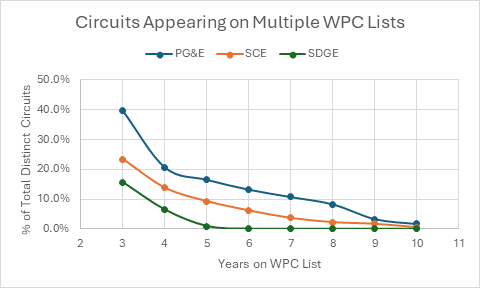
The figure above shows what percentage of the worst performing circuits from each utility stay on the worst performing circuit list for multiple years. This data is taken from utility Top 1% Worst Performing Circuit requirement from D.16-01-008. Remediation efforts tend to ensure that all but a small fraction of persistently poor performing circuits do not stay on the list for more than 5 to 6 years. However, projects to address these worst performing circuits tend to take a long time due to location and environmental concerns.
The CPUC uses this information to better understand how different infrastructure conditions affect reliability performance across California.
Utilities use a range of approaches to improve reliability, including equipment upgrades, protective devices, undergrounding, fault detection systems, and infrastructure improvements designed to reduce outage duration and limit customer impacts.
Supporting Future Reliability Planning
The CPUC is also examining how reliability oversight may evolve in response to changing grid conditions.
In 2024, the CPUC opened a Rulemaking (R.24-05-023) focused on electric distribution reliability. The effort is evaluating how utilities collect and report reliability information while considering issues such as aging equipment, climate-driven weather events, wildfire mitigation practices, equity, and long-term reliability investment priorities.
The proceeding is also exploring more detailed reporting approaches that could provide reliability information at a more localized level.
The CPUC has also issued Decision 26-08-007 in R.24-05-023 that enhances current reliability reporting requirements with more granular, geographically coordinated data to help the CPUC understand outage trends and underlying causes, as well as to understand whether Environmental and Social Justice communities are being disproportionately affected by poor reliability. The Decision requires utilities to submit a narrative report, as well as a broad range of data outlined in a template developed by the utilities, stakeholders, and CPUC staff to give the CPUC a better and much more in-depth understanding of exactly where, when, and how outages are happening.
As California’s energy system continues to evolve, reliability metrics remain one of the key tools the CPUC uses to understand grid performance, identify risks, and support decisions aimed at maintaining safe and dependable electric service for customers across the state.
More Information
By Adam Cranfill, Public Information Officer