
Resource Adequacy Homepage
Contents
- Goals of the Resource Adequacy Program
- Program Overview
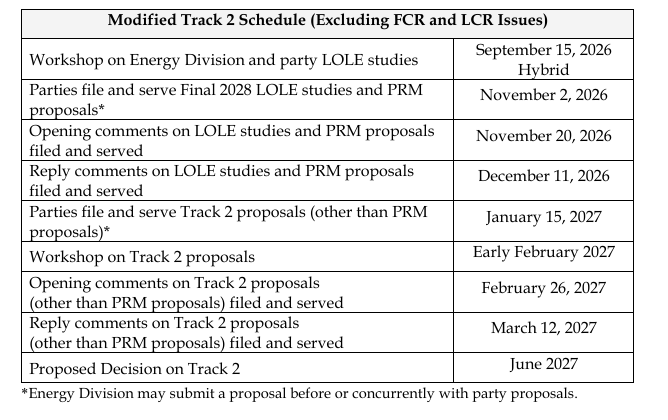
- RA Proceeding Calendar (R.23-10-011)
- Recent RA Decisions
- Useful Resources
Goals of the Resource Adequacy Program
The Resource Adequacy program has two goals:
- To ensure the safe and reliable operation of the grid in real-time providing sufficient resources to the California Independent System Operator (CAISO) when and where needed.
- To incentivize the siting and construction of new resources needed for future grid reliability.
Program Overview
The CPUC adopted a Resource Adequacy (RA) policy framework (Public Utilities Code section 380) in 2004 to in order to ensure the reliability of electric service in California. The CPUC established RA obligations applicable to all Load Serving Entities (LSEs) within the CPUC’s jurisdiction, including investor-owned utilities (IOUs), energy service providers (ESPs), and community choice aggregators (CCAs). The Commission’s RA policy framework – implemented as the RA program - guides resource procurement and promotes infrastructure investment by requiring that LSEs procure capacity so that capacity is available to the CAISO when and where needed.
The CPUC’s RA program now contains three distinct requirements: System RA requirements (effective June 1, 2006), Local RA requirements (effective January 1, 2007) and Flexible RA requirements (effective January 1, 2015).
-
Requirement Determination System RA Each LSEs CEC-adjusted forecast plus a planning reserve margin of 17% (beginning in 2024) Local RA Annual CAISO study using a 1-in-10 weather year and an N-1-1 contingency Flexible RA Annual CAISO study that currently looks at the largest three-hour ramp for each month needed to run the system reliability There are two type of filings: Annual filings (filed on or around October 31st) and Monthly filings (filed 45 calendar days prior to the compliance month). Commission staff evaluates LSE filings annually and monthly to ensure accuracy and completeness.
For the annual filings, LSEs are required to make an annual System and Flexible compliance showing for the coming year. For the System showing, each LSEs is required to demonstrate that it has procured 90% of its System RA obligation for the five summer months of the coming compliance year. Additionally, each LSE must demonstrate that it meets 90% of its Flexible RA obligation for all twelve months.
For LSEs in the San Diego local distribution area only, each LSE has a three-year forward local obligation and must meet 100% of its local requirement for the years one and two and 50% of for year three.
For the monthly filings, LSEs must demonstrate they have procured 100% of their monthly System and Flexible RA obligation. Additionally, on a monthly basis from July through December, LSEs in the San Diego local distribution area must demonstrate they have met their revised (due to load migration) local obligation. LSEs in SCE and PGE local distribution areas are no longer required to demonstrate 100% local RA compliance as the Central Procurement Entity assumed responsibility for local in those areas as of 2023 compliance.
Showing
Annual
(Filed on or around 10/31)Monthly
(Filed 45 days prior to compliance month)SystemLSE must demonstrate procurement of 90% of System RA obligation
for the five summer months of the coming compliance yearLSE must demonstrate procurement of 100%
of their monthly System RA obligationLocal For its three-year forward obligation, each LSE in the SDGE area must demonstrate procurement of 100% of Local RA obligation for each month of compliance years one and two and 50% of Local RA obligation for year three. For LSEs in the SCE and PGE local procurement need only be demonstrated for 2022. From July to December, LSE must demonstrate procurement
of their revised (due to load migration) Local RA obligationFlexible LSE must demonstrate procurement of 90% of Flexible RA obligation
for each month of coming compliance yearLSE must demonstrate procurement of 100% of their monthly
Flexible RA obligationCommission staff evaluates LSE filings annually and monthly ensure accuracy and completeness. Commission staff also lead annual RA proceedings to refine the RA program, the most recent of which is R.25-10-003.
Current RA Proceeding: R.25-10-003
Recent Decisions
Decision D.26-07-008 - Decision Adopting Local Capacity Obligations For 2027-2029, Flexible Capacity Obligations For 2027, And Program Refinements.
Decision on Track 3 of Resource Adequacy
Decision on Track 2 of Resource Adequacy
Decision on Track 1 of Resource Adequacy
Decision on Phase 3 of the Resource Adequacy Implementation Track
D.23-06-029Decision on Phase 2 of the Resource Adequacy Reform Track
D.23-04-010Useful Resources:
Report on Slice of Day Transactability
Report of the Central Procurement Entity (CPE) Framework
Report on RA Slice of Day Implementation and Year Ahead Showings
System Reliability Modeling:
Resource Adequacy Reports:- 2023 Resource Adequacy Report
- 2022 Resource Adequacy Report
- 2021 Resource Adequacy Report
- 2020 Resource Adequacy Report
- 2019 Resource Adequacy Report
- 2018 Resource Adequacy Report
- 2017 Resource Adequacy Report
- 2016 Resource Adequacy Report
- 2015 Resource Adequacy Report
- 2013-2014 Resource Adequacy Report
- 2012 Resource Adequacy Report
- 2011 Resource Adequacy Report
- 2010 Resource Adequacy Report
- 2009 Resource Adequacy Report
- 2008 Resource Adequacy Report
- 2007 Resource Adequacy Report
- 2006 Resource Adequacy Report
Resource Adequacy Market Reports:
[1] Energy Division may also serve a proposal, either prior to or concurrently with parties.