Bringing the Benefits of Solar Home: How SOMAH Expands Bill Credits

For many Californians, putting solar panels on the roof is not a decision they can make. Millions of people live in apartments and other multifamily housing where decisions about rooftop solar and battery storage are made by property owners. For residents of affordable housing, this creates a barrier to any potential savings that come with installing solar.
The California Public Utilities Commission’s (CPUC) Solar on Multifamily Affordable Housing (SOMAH) Program is designed to help close that gap. SOMAH provides financial incentives for solar energy systems at qualifying multifamily affordable housing properties.
“SOMAH is designed to enable tenants of participating properties to receive bill relief from solar generation where they live," says Thovie Michaud-Gonzales, CPUC SOMAH Lead Analyst. "Across California, we're making bills more affordable while also contributing to our state’s climate goals.”
Turning Sunshine into Savings
When most people think about rooftop solar, they may picture panels on a single-family home and a homeowner watching their electricity use and bill change as the system produces energy.
SOMAH brings the benefits of solar to a different setting.
At participating properties, solar generation can serve both tenants and common areas, such as hallways, laundry rooms, and community spaces. Tenants receive credits on their electricity bills from the solar energy produced at their property, helping reduce their monthly electricity costs.
That connection between clean energy generation and household savings is a central part of SOMAH. The program goal is to lower tenant energy bills at participating properties. According to the May 2026 SOMAH Evaluation Report, in 2025, tenants, on average, saved $58/month, which came out to about 75 percent of their average monthly bill.
For a household balancing housing, food, transportation, and other expenses, reducing an electricity bill can have meaning beyond reducing the use of energy. It is money that can remain in the household budget.
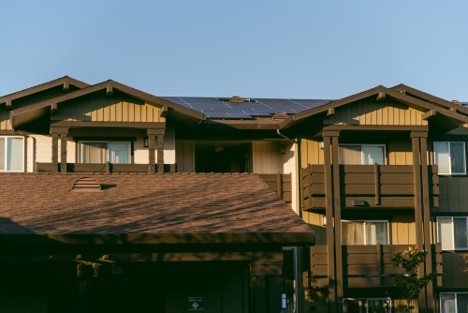
Completed SOMAH project in Suisun City.
Advancing the Clean Energy Transition
SOMAH also specifically encourages solar installations in disadvantaged communities, extending the bill credits of clean energy investment into rooftop solar subsidized programs.
The result is a model in which a solar installation on an apartment building can do more than generate electricity, it can provide financial benefits to the building tenants.
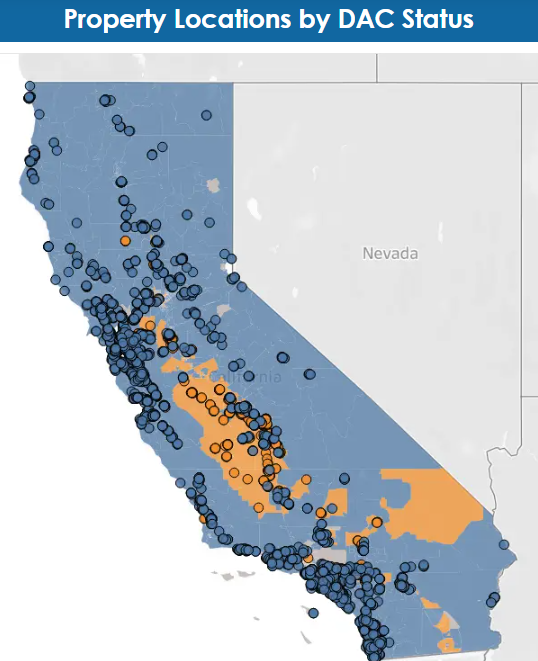
SOMAH eligible properties map.
How Solar Credits Reach Residents
One of the tools that makes this possible is virtual net energy metering.
Instead of requiring every apartment to have its own individual set of solar panels, virtual net energy metering allows the benefits produced by an eligible renewable energy system to be shared among multiple electricity accounts at a property.
Property owners can allocate the benefits of the system between common areas and tenant accounts. Solar credits then appear on participating customer electricity bills as energy offsets with compensation for eligible exported electricity.
Tenants are not responsible for operating or maintaining the solar system, and a rent increase cannot be attributed to the installation of the solar system funded by the SOMAH program.
Incentives for Property Owners
For property owners, SOMAH incentives could offset up to the whole cost of the system, including the cost of materials and installation of an eligible solar system. This can offset the electricity needs of tenants and common areas, helping to reduce and stabilize energy costs at multifamily properties. According to the May 2026 SOMAH Evaluation Report, in 2025 property owners saved $1,977/month on average, or about 68 percent of the average common-area monthly bill.
Benefits That Extend Beyond the Electricity Bill
SOMAH also includes job training opportunities for eligible participants, providing pathways into California’s clean energy workforce. In the recent program evaluation survey, 85 percent of participating job trainees said they obtained a job in the solar industry. Participating tenants are also automatically enrolled in an Energy Savings Assistance Program, providing another opportunity to reduce household energy use.
Taken together, those benefits illustrate the broader purpose of the program: using California’s clean energy investments to create tangible benefits for residents, affordable housing properties, and communities.
Building Toward 300 Megawatts
SOMAH grew out of Assembly Bill 693, which established financial incentives for installing solar energy systems on multifamily affordable housing properties. The CPUC established the program design in 2017, and SOMAH began accepting applications in 2019. The program is working toward developing at least 300 megawatts of installed solar generating capacity by Dec. 31, 2032. As of mid-2026, SOMAH projects completed or moving through the pipeline account for about 139 megawatts of the program's 300-megawatt goal, with roughly 58 megawatts already up and running.
The scale is important, but megawatts tell only part of the story.
That is why programs such as SOMAH matter. California’s energy transition is not only about how electricity is generated, but also about delivering bill relief and tangible savings. By bringing solar to multifamily affordable housing and directing economic benefits to the people who live there, SOMAH is helping make those benefits available to more Californians.
The Benefits of SOMAH from a Tenant's Perspective
Interview of SOMAH program recipient provided by the SOMAH program.
More information:
By Adam Cranfill, Public Information Officer