CPUC Streamlines Utility Acquisitions to Improve Access to Affordable Clean Water
Crescent Bay acquisition in Clearlake a model of success
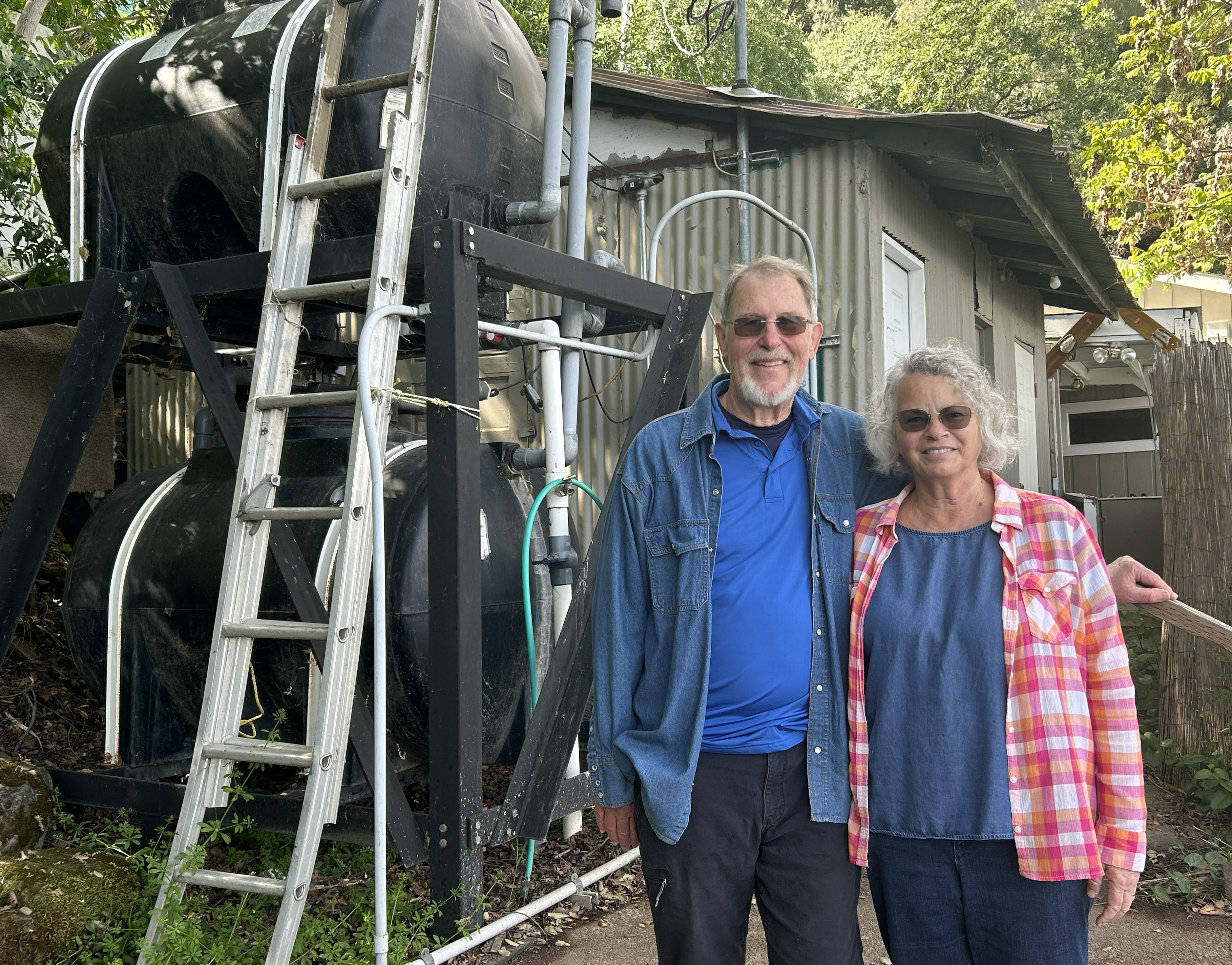 Mary and Norm Benson stand next to the small water utility they operated in Clearlake.
When Mary and Norm Benson’s small community of Clearlake needed someone to step up and run the town’s small water operation system, they did not hesitate to volunteer. The couple obtained their water treatment licenses and balanced the task of running the little utility on top of working their full-time jobs.
But the daily tasks and overdue maintenance quickly became too much for the couple to handle. The small operators were using diatomaceous earth filtration, a method that both filters and treats the water coming from the water supply source at Clear Lake, and had to constantly carry filtration supplies down 150 stairs during the process.
“We had 50-pound bags that we had to get down the hill to the plant. We also had to carry down 40-pound boxes of chlorine, so it was a lot of work. Even if we had the use of a tram a few houses over, you still had to go across a rocky beach and carry things while stumbling,” Mary Benson said.
“It was the most challenging thing I may have ever done. I had very supportive customers, they were my friends, they were my neighbors. These were people that I wanted to do the best job I could for,” Norm Benson said.
The water utility, Crescent Bay Improvement Company, could not meet federal and state drinking water standards, leaving 24 households reliant on bottled water. With the water utility facing financial hardship and unable to pay for upgrades, the couple looked to the state for help and were thrown a lifeline.
 Mary and Norm had to regularly climb a steep staircase to manage their town’s small water utility.
The California Public Utilities Commission (CPUC) approved Golden State Water Company’s application to purchase Crescent Bay Improvement Company in what’s called a water utility acquisition. This means larger water utilities purchase smaller water utilities that may be failing or at-risk and take over the duties of providing safe, adequate, and affordable drinking water to ratepayers in that region.
Acquisitions relieve smaller utilities from the financial burden of overdue repairs and upgrades and spread these costs over a larger customer base to maintain infrastructure improvements. Additionally, acquisitions are a pathway to providing communities with safe, clean water.
“I think acquisition is one of the best solutions available, because the larger companies have a deeper bench of talent, equipment, and resources. They also have a direct line of communication with the regulators and the funding sources. I also think that the economies of scale play into it in a big way. Their costs for items such as chlorine were so much less than ours because they could buy in bulk,” Mary Benson said.
As part of the acquisition, Golden State Water Company received a grant from the California State Water Resources Control Boards’s SAFER program to pay for infrastructure improvements to treat Clear Lake surface water.
The CPUC’s Water Division regulates 84 water utilities divided into four classes based on size, serving 16 percent of California. Since 2007, the CPUC has approved 79 water utility acquisitions statewide, including in Kern, Lake, Los Angeles, Placer, Shasta, and Sutter Counties.
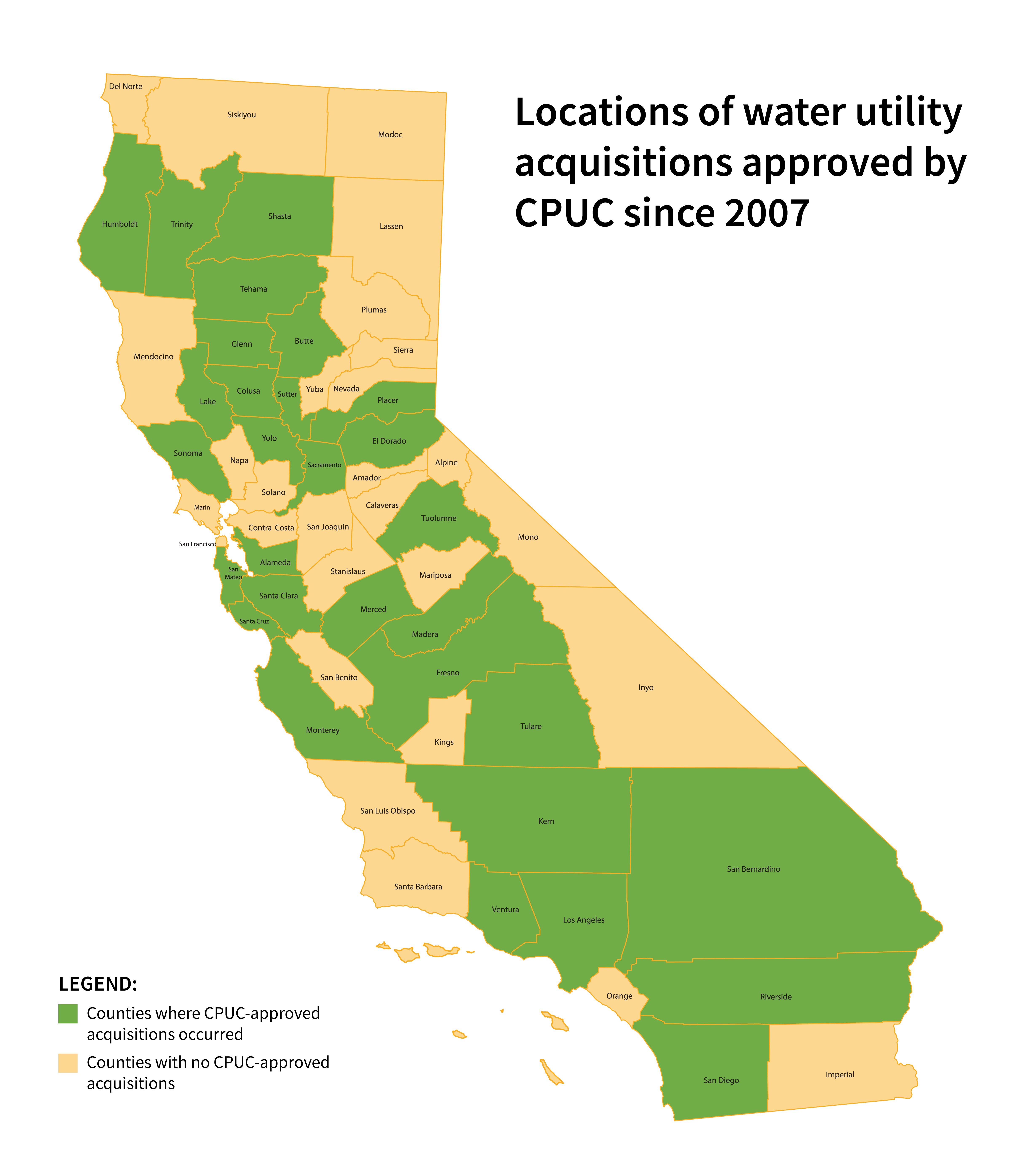
Map showing counties where acquisitions have occurred in California.
The CPUC and its state partners look at acquisitions as a long-term strategy to improve access to clean water. One of the Water Division’s main priorities in 2026 is the Water Acquisitions Proceeding which focuses on streamlining the lengthy process so larger water utilities can provide economies of scale in acquiring smaller, at-risk water utilities. Water Division Staff issued a proposal in the proceeding that includes the following:
➡️Improving and streamlining the acquisition process by the CPUC’s Water Division holding a Prefiling Conference ahead of a water utility filing an acquisition application with the CPUC to identify potential project holdups and adequate funding sources to minimize delays.
➡️Incentivizing the acquisition of failing or at-risk water systems and expediting the review time by shortening the CPUC Advice Letter process and water utility application process. The application process for at-risk utilities could shorten from 18 to 12 months.
➡️Using accurate valuation of water systems to ensure costs are reflective of the current expenses to acquire a water utility by the CPUC considering the fair market value in addition to the purchase price when determining the rate base.
➡️Ensuring transparency to ratepayers by requiring a rate impact analysis from utilities seeking acquisition comparing proposed rates to current rates.
➡️Increasing coordination with the California State Water Resources Control Board by bridging services during acquisitions, creating a pathway from the CPUC’s decision-making process to the Water Board’s SAFER Grant Program, which provides essential funding for water infrastructure improvements.
Acquisitions support the CPUC’s mission to ensure investor-owned water utilities deliver clean, safe, reliable, and affordable water.
“Acquisitions offer relief for communities with at-risk or failing water utilities that are struggling financially and unable to provide clean water. Seeing the results and the quality of life improve in communities is rewarding, as the CPUC is entrusted to maintain water quality standards for Californians,” said Terence Shia, Water Division Director.
“There are many at-risk water systems in the state. Acquisition of failing water systems by better-resourced utilities is a key tool for addressing the needs of those failing or at-risk systems,” said Commissioner Darcie L. Houck. “It is important to have a clear and streamlined process for utilities that are moving forward with these acquisitions so the commission can timely process their applications and ensure communities have clean, safe drinking water. The process we are setting up here is a critical piece to meeting the State’s Human Right to Water Policy.”
Mary is grateful that her town now has access to reliable water utility services. She sees acquisitions as a solution for other small operators struggling to provide services to their communities.
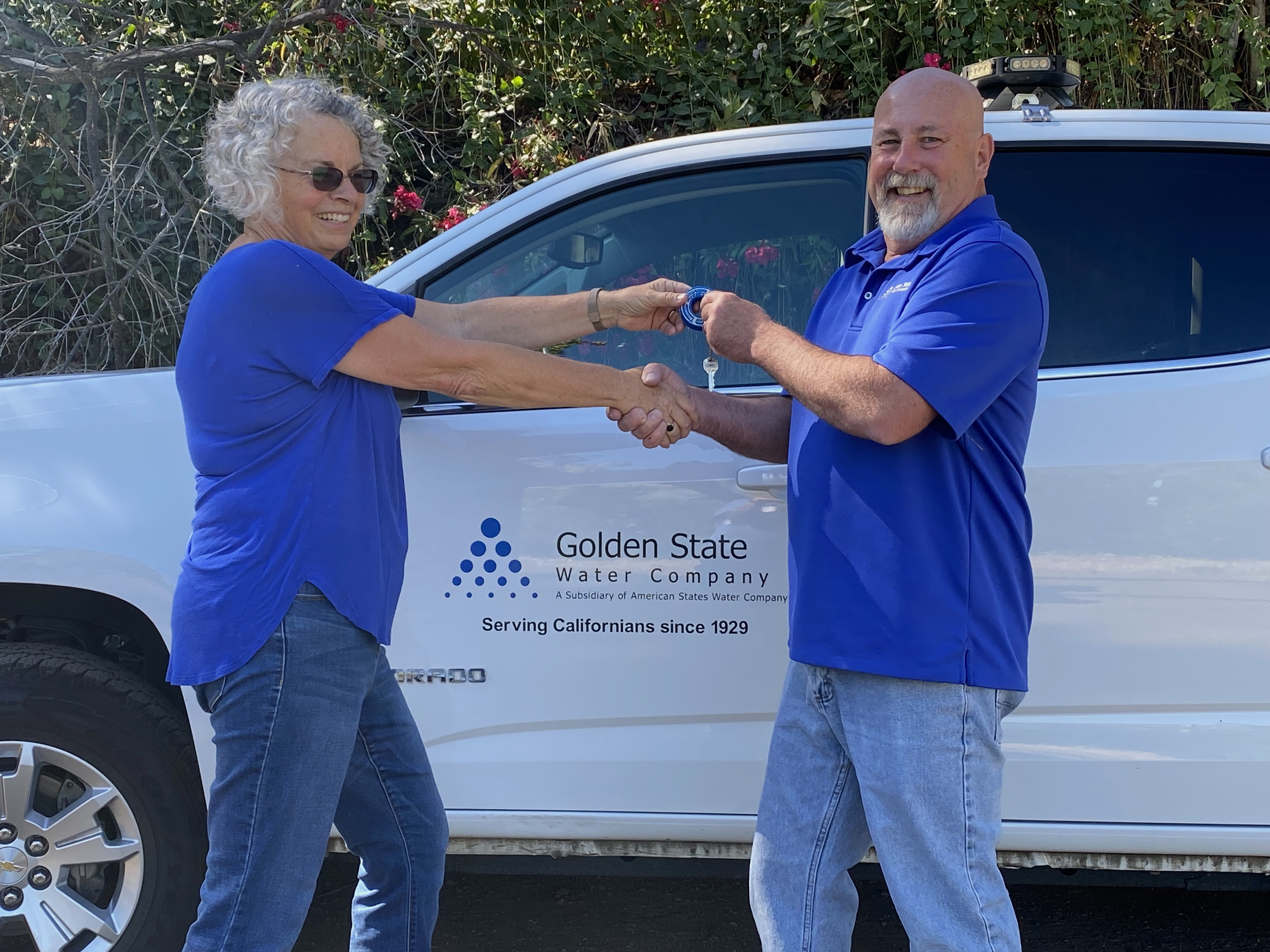 Key handover after Golden State Water Company acquired Crescent Bay Improvement Company.
“We are so happy that we no longer have this weight on our shoulders 24 hours a day," Mary Benson said.
By Andrea Marvin, Public Information Officer