Don’t Be Fooled: What to Know About Abusive Marketing
Featured Story
.png?mw=1440&hash=D4F3C34A1F24BEC4C6BBC4255840568C)
Have you ever received a call or a knock on your door from someone saying they can lower your energy bill or give you a special rate, only to find out you have been misled? This is sometimes referred to as “abusive marketing,” and it can be confusing and frustrating.
What Is Abusive Marketing?
Abusive marketing happens when companies pressure or mislead you into switching to their service.
An example of this is marketing by some Core Transport Agents (CTAs), which are allowed to sell natural gas to homes and small businesses. Many CTAs are reputable companies, but some may use questionable marketing tactics. For example, someone might call and say, “We work with your natural gas company and can lower your bill,” when they work for a completely different company. Others might say you need to switch to their company immediately or risk losing your discount.
In the California Public Utilities Commission’s (CPUC) Consumer Affairs Branch (CAB), representatives assist consumers with billing and service matters. In the first nine months of 2025 alone, CAB received and is assessing 2,406 CTA complaints, nearly 70 percent of which allege abusive marketing.
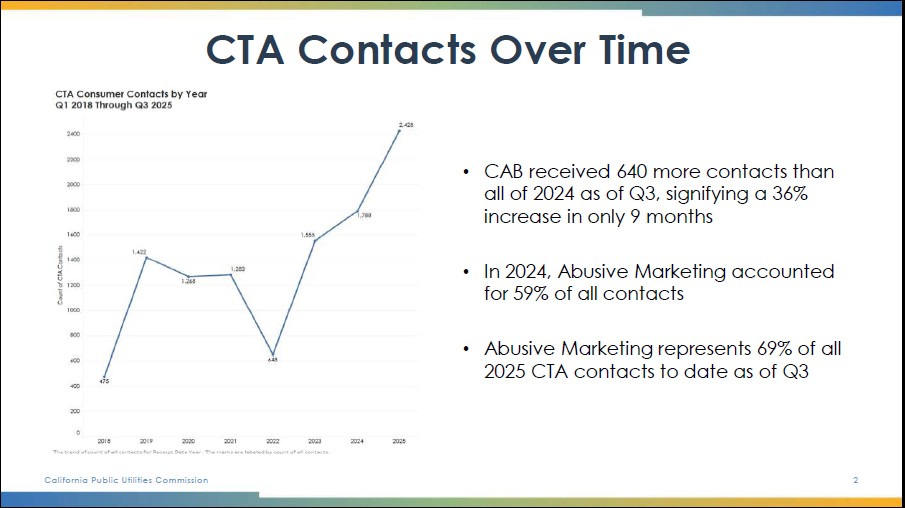
Consumer complaints received by CAB against energy marketers rose in 2025, with nearly seven in 10 of such complaints related to abusive marketing tactics.
Who Is Being Targeted and Why It Matters
The CPUC’s analysis shows that abusive marketing doesn’t affect everyone equally. Many complaints come from disadvantaged and environmental and social justice communities (ESJ), where English may not be the primary language and residents may be less familiar with complex utility contracts.
In 2025, 40 percent of all abusive marketing complaints came from California’s most disadvantaged neighborhoods, where median household incomes are less than half the statewide average. These areas include sections of Fresno, Modesto, Stockton, and clusters in Oakland, San Francisco, and Vallejo.
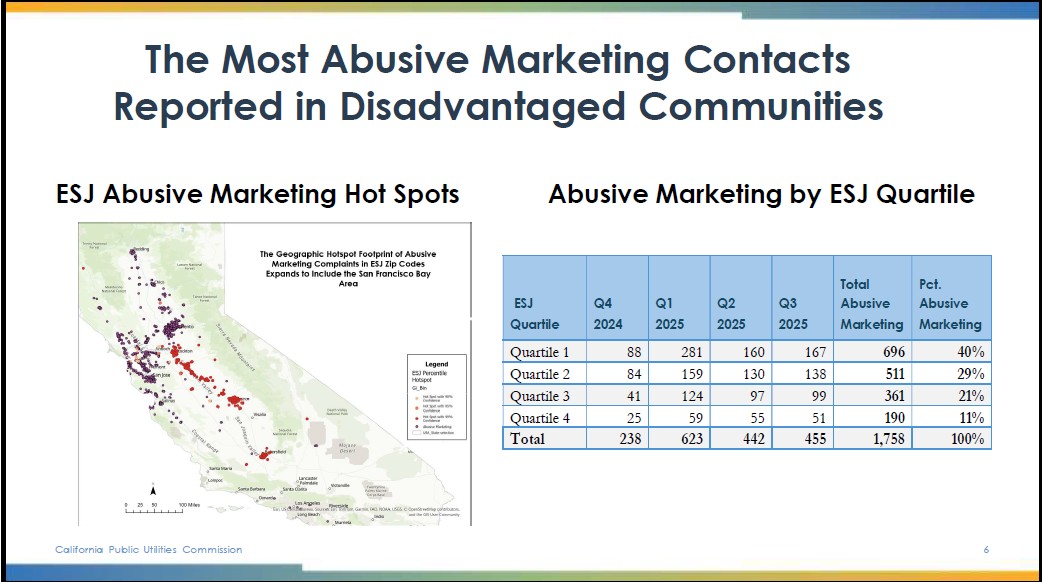
Most contacts to CAB came from the state’s most disadvantaged areas (Quartile 1).
“In zip codes where many residents don’t speak English at home or where there’s a high concentration of older adults over 65 years old, complaint ‘hot spots’ light up on CAB’s maps,” said Linette Young, a CAB Senior Analyst. “These groups are particularly vulnerable to misleading claims, high-pressure sales, or where customers are switched to another provider without consent.”
How It Happens
These issues can manifest in many ways:
- You receive a phone call or a knock on your door and a salesperson says you’ll get “lower rates” on your bill but doesn’t explain or mention the other charges associated with the service.
- A salesperson knocks at your door and says they are representing your utility company and have a special program for you and they ask to see your utility bill.
- You receive a phone call or are told at your door that the utility has a special program for seniors to lower their bill.
Anyone can fall for these tactics, especially when the person contacting you seems trustworthy or speaks your native language.
What the CPUC Is Doing to Help
The CPUC oversees utility companies to make sure utilities follow rules and regulations and treat customers fairly. Through CAB, the CPUC works with utility customers to resolve billing and service complaints.
The CPUC also funds two programs that help Limited English Proficiency (LEP) consumers directly:
- Telecommunications Education and Assistance in Multiple Languages (TEAM)
- Community Help and Awareness of Natural Gas and Electric Services (CHANGES)
These programs work with trusted community-based organizations to help people understand their bills, report scams, and get help in their native language. When the CPUC finds a pattern, such as a company targeting vulnerable neighborhoods or failing to resolve repeated outages, it can open staff investigations and take stronger actions.
What You Can Do
If someone contacts you with a deal that sounds too good to be true, take your time. Ask questions. Verify the company’s name and whether they represent your utility. Check with the Better Business Bureau. Ask for the offer in writing before agreeing to anything. Read every document carefully.
If you believe you’ve been misled, contact CAB. Your complaint helps the CPUC identify bad actors and protect others in your community.
📍File a complaint: Contact the CPUC’s Consumer Affairs Branch
By Taseen Shamim, Public Information Officer