
San Bruno Incident
Pacific Gas and Electric Company Natural Gas Transmission Pipeline Rupture and Fire in San Bruno on September 9, 2010
Summary of the incident
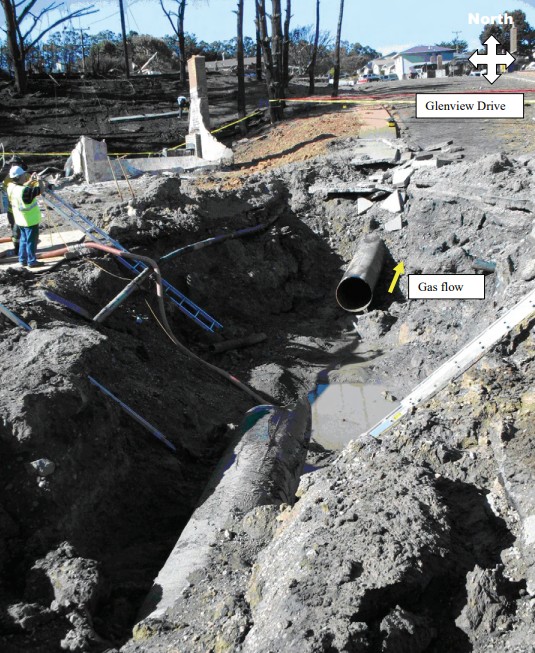
On September 9, 2010, at approximately 6:11pm, a 30-inch diameter natural gas transmission pipeline owned and operated by PG&E ruptured in San Bruno, California. Gas escaping from the rupture ignited resulting in the loss of eight lives, injuries to 58 people, destruction of 38 homes, moderate to severe damage to 17 homes and minor damage to 53 homes.
The incident was preceded by maintenance activity at the Milpitas Terminal. The Milpitas Terminal receives gas from Texas and the Rocky Mountain Area and distributes it into 8 pipelines.
At 2:46pm on September 9, clearance to replace an Uninterruptable Power Supply (UPS) at the Milpitas Terminal was initiated. During the installation of the UPS, power was lost to the Supervisory Control and Data Acquisition (SCADA) system, resulting in loss of some information and control over various pipelines at the Milpitas Terminal.
This, in turn, caused various regulating valves to fully open as designed. Gas pressure in lines leaving the Milpitas Terminal increased causing the pipeline rupture in San Bruno. Energy released from the rupture created a crater about 72 feet long by 26 feet wide. A 28-foot long section of pipe weighing approximately 3,000 pounds was ejected from the crater and landed approximately 100 feet from the crater in the middle of Glenview Drive.

National Transportation Safety Board (NTSB) Conclusion
The National Transportation Safety Board determines that the probable cause of the accident was the Pacific Gas and Electric Company’s (PG&E) (1) inadequate quality assurance and quality control in 1956 during its Line 132 relocation project, which allowed the installation of a substandard and poorly welded pipe section with a visible seam weld flaw that, over time grew to a critical size, causing the pipeline to rupture during a pressure increase stemming from poorly planned electrical work at the Milpitas Terminal; and (2) inadequate pipeline integrity management program, which failed to detect and repair or remove the defective pipe section.
Contributing to the accident were the California Public Utilities Commission’s (CPUC) and the U.S. Department of Transportation’s exemptions of existing pipelines from the regulatory requirement for pressure testing, which likely would have detected the installation defects. Also contributing to the accident was the CPUC’s failure to detect the inadequacies of PG&E’s pipeline integrity management program.
Contributing to the severity of the accident were the lack of either automatic shutoff valves or remote control valves on the line and PG&E’s flawed emergency response procedures and delay in isolating the rupture to stop the flow of gas.
See NTSB - Pacific Gas and Electric Company Natural Gas Transmission Pipeline Rupture and Fire.
CPUC Consumer Protection & Safety Division (CPSD) Conclusion
According to the CPSD Staff Report on San Bruno Explosion OII, PG&E did not maintain a safe condition on Segment 180 of Line 132 in San Bruno, California. Many factors contributed to the unsafe condition, including the installation of substandard pipe, failing to follow accepted industry standards during construction, failing to perform adequate inspections, failing to keep adequate safety records, failing to comply with the integrity management rules, failing to operate safely at the Milpitas Terminal, failing to promptly and safely respond to the incident, and management failing to foster a culture that valued safety over profits at PG&E.
These factors all contributed to the explosion and fire at San Bruno on September 9, 2010, and together constitute an unreasonably unsafe condition on Segment 180 that lasted from 1956 to 2010, in violation of Public Utilities Code Section 451. During construction of Segment 180 PG&E did not comply with the then-current industry standards for construction of its pipelines in violation of ASA B31.1.8 standards, creating an unsafe condition in violation of Section 451. Specifically, PG&E did not follow the established detailed requirements in ASA B31.1.8-1955 on yield strengths in pipe materials (Section 805.54 of B31.1.8), welding (Section 811.27), fabrication (API 5LX), testing (Section 841.411), records of testing (Section 841.417), and establishing MAOP (Section 845.22).
PG&E violated various requirements of 49 CFR Part 192, Subpart O, in its implementation of the Integrity Management process, including incomplete data gathering and integration, flawed threat identification, flawed risk assessment and using an incorrect assessment methodology. This allowed an unsafe condition to persist in violation of Section 451. By erasing a digital video recording made during the incident at its Brentwood control room, PG&E destroyed potentially relevant information in violation of Commission Resolution L-403 which specifically ordered PG&E to preserve any potential evidence.
See CPSD Staff Report.
CPUC Regulatory Response
New Regulations, Codes, and Orders since the San Bruno Explosion:
- California Codes – Natural Gas Pipeline Safety Act of 2011 (Public Utilities Code Sections 955-969)
- Federal Regulations – Pipeline and Hazardous Materials Safety Association (PHMSA) released “the Mega Rule” in September of 2019
- CPUC Enforcement Policy – CPUC adopted a transparent and uniform Enforcement Policy in 2020. See Enforcement and Citations.
Pipeline Strength Testing:
- Since 2011, Pacific Gas and Electric Company has strength-tested a total of 1,620 miles of natural gas transmission pipeline.
- Since 2011, SoCalGas has strength-tested 368 miles.
- Since 2011, SDG&E has strength-tested 15 miles.
Natural Gas Safety Action Plan
The 2010 rupture of a PG&E natural gas pipeline in San Bruno, California, was a game-changer for the CPUC. The CPUC created a comprehensive, high-level, Gas Safety Action Plan to guide and promote the CPUC’s shift in culture from the traditional compliance model to a regulatory structure that sets, monitors, and enforces rules for regulated utilities based on risk assessment and risk management. See Natural Gas Safety Action Plan.
CPUC Financial Response
CPUC Decision D.15-04-024 adopted penalties to be imposed on Pacific Gas and Electric Company (PG&E) for violations arising from: (1) the September 9, 2010 San Bruno explosion and fire; (2) PG&E’s recordkeeping practices for its gas transmission pipeline system; and (3) PG&E’s failure to maintain the proper class designation for pipelines in areas of higher population density. The Commission imposed a fine and other penalties and remedies totaling $1.6 billion. This consisted of:
· $850 million in future gas infrastructure improvements related to transmission pipeline safety to be paid for by PG&E shareholders;
· $300 million fine payable to the General Fund;
· $400 million bill credit to PG&E’s gas ratepayers in the form of a one-time bill credit; and
· Approximately $50 million to implement over 75 remedies proposed by the Commission’s Safety and Enforcement Division previously called the Consumer Protection and Safety Division (CPSD) 1 and other intervenors to enhance pipeline safety.
See Decision on Fines and Remedies on PG&E.
PG&E Remedies
CPUC Decision D.15-04-024 adopted additional, specific remedies, as discussed in Section 7 of the CPUC Decision D.15-04-024. These remedies were at shareholder expense and were estimated to cost at least $50,000,000.
See Section 7 of Decision on Fines and Remedies on PG&E for more detail on PG&E’s remedies.
Industry response
The PG&E San Bruno incident underscored the need for PHMSA to extend IM requirements and address other issues related to pipeline system integrity. In response, PHMSA has finalized requirements that address the causes of several recent incidents, including the PG&E San Bruno incident, by clarifying and enhancing existing requirements.
PHMSA has revised the Federal Pipeline Safety Regulations to improve the safety of onshore gas transmission pipelines. This final rule addresses congressional mandates, National Transportation Safety Board recommendations, and responds to public input. The amendments in this final rule address integrity management requirements and other requirements, and they focus on the actions an operator must take to reconfirm the maximum allowable operating pressure of previously untested natural gas transmission pipelines and pipelines lacking certain material or operational records, the periodic assessment of pipelines in populated areas not designated as “high consequence areas,” the reporting of exceedances of maximum allowable operating pressure, the consideration of seismicity as a risk factor in integrity management, safety features on in-line inspection launchers and receivers, a 6-month grace period for 7-calendar-year integrity management reassessment intervals, and related recordkeeping provisions.
See Pipeline Safety Rule By PHMSA.
PG&E improvement statistics
Pacific Gas and Electric Company (PG&E) has submitted to the California Public Utilities Commission (CPUC) its final report on the company’s Pipeline Safety Enhancement Plan (PSEP) mandated by the CPUC after the San Bruno Explosion. The report details the hundreds of projects undertaken by PG&E to implement safety, operational reliability and environmentally-focused upgrades and enhancements to its natural gas transmission pipeline system.
The PSEP was formally submitted to the CPUC on August 26, 2011, with the goal of enhancing safety and improving operations of the gas transmission pipeline system, which now totals approximately 6,600 miles. PG&E completed 585 projects that include installing automated valves, strength testing, replacing, upgrading, and in-line inspecting (ILI) its system. The last PSEP project became operational in November 2018.
Upgrades to the gas transmission pipeline system under the PSEP project include:
- Completed 673.5 miles of strength testing.
- Replaced 114.9 miles of transmission pipe, downrating 12.0 miles to distribution system and retiring 9.1 miles of pipeline.
- Upgraded 202.4 miles of pipeline to accept ILI technology.
- Installed 217 automated valves.
- Completed the records collection and maximum allowable operating pressure validation of PG&E’s entire transmission pipeline system.
- Made material improvements in PG&E’s records processes and system and application tools.
See PG&E Submits Final Report on Gas Pipeline Safety Enhancement Plan to CPUC.
Links to the CPUC and NTSB investigation reports
See NTSB investigation report.
See CPSD Staff Report.