California Connectivity Stories: City of Ukiah
How a Small Northern California City is Wiring Its Own Future and Building Regional Resilience

The Last Mile
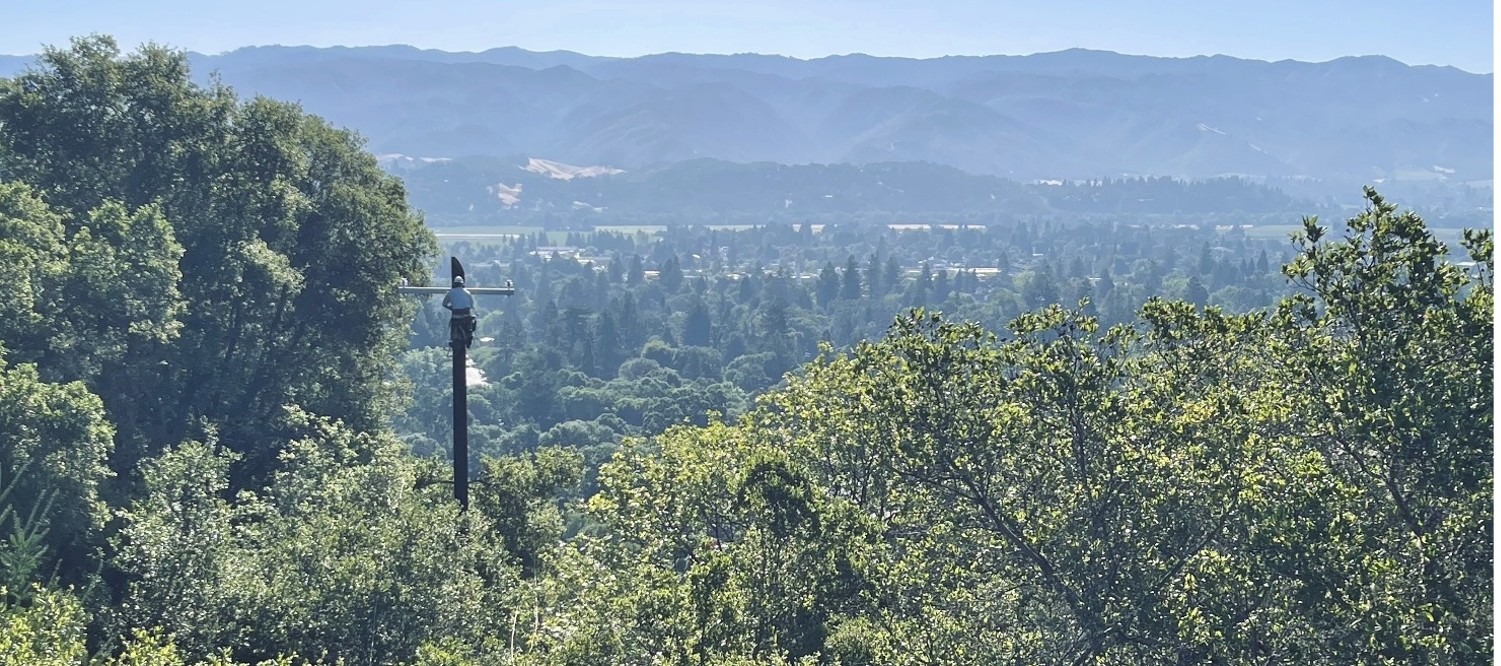
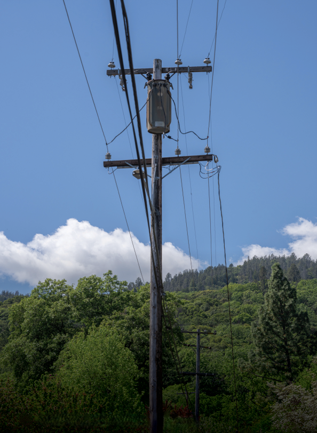
Utility poles in Ukiah, California, have been holding up City-owned electric lines since the early 1900s. This winter, crews began stringing fiber optic cables on those same poles.
Ukiah is a regional hub for people living in a large and sparsely developed part of Northern California. Located two hours north of San Francisco along Highway 101, you'd expect nearly everyone to be online. Instead, hundreds of residents are unserved and many more can't get affordable high-performing internet — the kind that lets you work, run a business, see a doctor, and help your kid with homework.
The City decided to fix the situation itself. Drawing on decades of experience running its own electric system, and backed by cross-sector partnerships, Ukiah is building a high-speed network that fits the community on its own utility poles.
The "last mile" is historically the most expensive part of the network to build, where rural and small communities get skipped over due to high construction costs relative to number of customers. But closing this digital divide provides a reliable lifeline for safety, health, and economic growth. This story is a snapshot of Ukiah's road to City-owned fiber broadband, with its internet partner Vero Fiber Networks and infrastructure funding from the California Public Utilities Commission.
Resilience and Safety for a Rural Hub
The name "Ukiah" is from the Pomo word "yokáya" meaning deep valley, or south valley. The Ukiah Valley is at the edge of some of the most fire-prone terrain in California, especially on the drier south- and west-facing slopes that are covered in Redwoods, Firs, and other dense vegetation.
As the seat of Mendocino County, people visit the City of Ukiah (population ~16,000) for essential needs including groceries, jobs, and healthcare as well as local cultural events and tourism. Andrea Trincado, who has managed Ukiah's broadband project and lived in the area for years, described the semi-rural community in a conversation about the evolution of the City's broadband project.
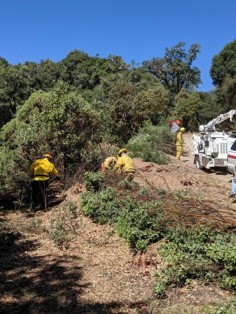
Reducing wildfire risks in the Ukiah Valley
The City has long taken seriously what it means to be a hub for the valley. Ukiah has owned and operated an electric utility since the early twentieth century, and has been undergrounding electrical lines in areas with the highest wildfire risk while prioritizing back-up power for critical facilities. The newly established Ukiah Climate Adaptation and Resilience Division formalizes their history of prioritizing health, safety, and sustainability.
The City works with Mendocino County, CAL FIRE, and others on resilience efforts. Among these initiatives, the Ukiah Emergency Fuels Reduction Project involved constructing 14 miles of shared fuel breaks where vegetation was altered to suppress fire at the edges of Ukiah's residential neighborhoods and the surrounding forested mountains in the valley. In 2021, fire protection was unified across the valley under a single district.
Another piece of resilience planning is getting alerts to people in time with reliable internet and emergency communications. Ukiah's Vice Mayor, Juan Orozco, described the impact of connectivity challenges leading up to the City's gigabit fiber project.
- Juan Orozco, Ukiah Vice Mayor
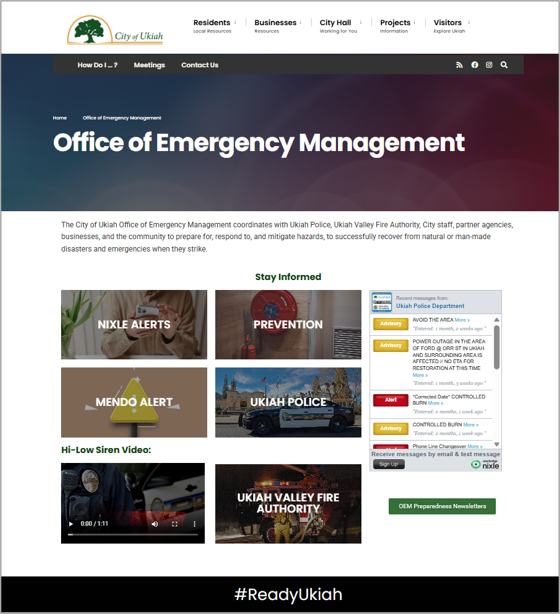
Office of Emergency Management - City of Ukiah, CA
Bridging the Distance
Another consequence of the connectivity gap that impacts the Ukiah Valley is healthcare. Since the COVID-19 pandemic in 2020, telehealth has shifted from a convenience to a basic need. In a region where the nearest specialist can be hours away, a missing or unreliable connection can be a barrier to care.
Trincado described how area residents without adequate internet have to drive long distances for medical appointments.
-Andrea Trincado, Ukiah Project Manager
Public health researchers have described broadband as a "super-determinant" of health that shapes access to care, education, and employment. The World Health Organization has noted that the communities with the most to gain from a connection are often the ones it reaches last, from the global South to the towns of Northern California. In this region where geography can be a barrier to care, improved connectivity will allow residents to access healthcare services from home, reducing travel burdens and improving health outcomes.
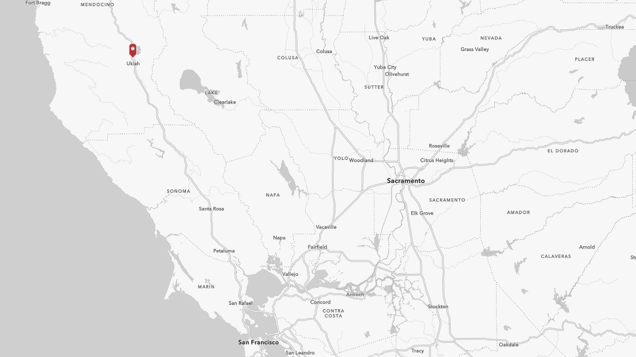
City of Ukiah California along Highway 101
Hurry Up
Jackeline Orozco (Jackie) runs a Spanish-language community newspaper, Periodico Al Punto, and adult education programs at Mendocino College. Her days can be a negotiation with the internet.
Jackie talked about how limited service is in much of the City, and where better options exist, they are expensive. She described how connectivity impacts her work and community roles, and her anticipation of the City's fiber network.
"I'm a business owner. I'm working on a deadline for my articles to be submitted or published. And sometimes I'm struggling with the internet. I need to go to another place. And at home, we would say, 'well, maybe you need to hurry up and end that meeting, because our son needs to get online."'
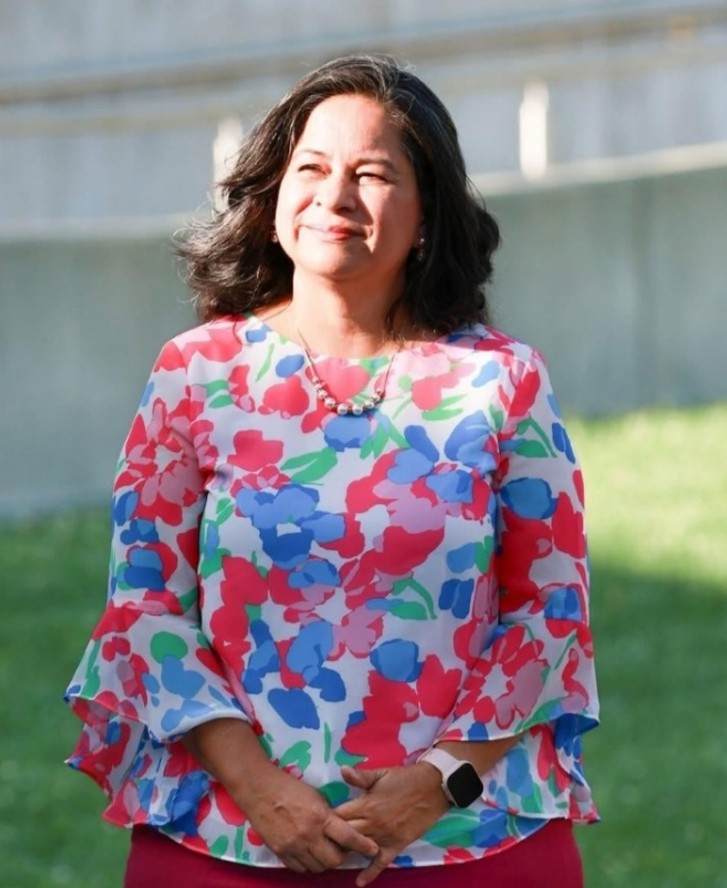
Jackie Orozco, Ukiah Business Owner and Educator
In December 2025, winter storms and power outages closed the college and sent staff home to work. But it was no better at home. With reports due to the U.S. Department of Education and Zoom meetings she couldn't miss, Jackie went out to search for a better signal.
Her students navigate similar challenges, and they rely on remote classes because their schedules make in-person attendance difficult or impossible. Jobs, children, and obligations don't follow a campus calendar.
Jackie described how she is always advocating for her students, because otherwise they can't get resources. When they can't get online, she said, "they are being left behind."
A facet of Ukiah’s connectivity situation that she returns to, "It's not all about consumption when it comes to the internet. It's very interactive. We need to submit things." A timesheet, a report, an exam, a job application. She talked about how the aging copper and coaxial lines threaded through Ukiah do not provide upload speeds that are critical for her students.
It was a big relief when Jackie first learned that the City would build a network of its own. She said that the prospect of a connection they could count on for symmetrical high speeds felt like a door opening for the people most used to finding it closed.
Ukiah Gigabit Fiber will connect hundreds of unserved residents, businesses and anchor institutions, while providing a new and improved option to thousands of others that have been reliant on limited options available locally.
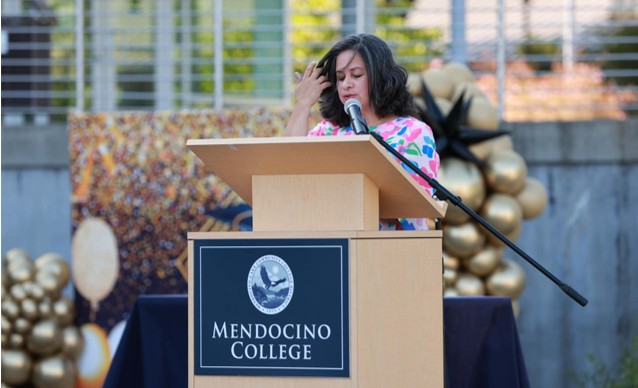
Jackie Orozco speaking at Mendocino College
Leveraging City Assets
Things visibly changed in early 2026, when Ukiah broke ground on a City-owned fiber broadband network, Ukiah Gigabit Fiber with its internet partner Vero Fiber Networks. More than ten years in the making, Ukiah built on assets it already owned: utility poles, rights of way, and experience running its electric system.
Seeing fiber being installed on poles, it's almost easy to overlook the years of work involved. The City's network took shape in parallel with a growing demand for affordable and reliable local internet options and the fundamental shift to online life around the COVID-19 pandemic.
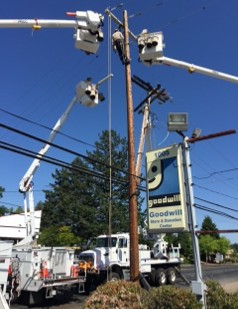
Installing fiber on North State Street
Ukiah's project manager described 2022 as a turning point, when they received a state planning grant that led to a Broadband Master Plan based on a public-private partnership model. The City would leverage infrastructure they own, while a qualified internet service provider would design, build, and operate the system as the most practical path forward.
The plan also recommended that the City and service provider partner on a state broadband infrastructure grant to help establish the network, recognizing that fiber start-up costs were too high to justify private investment in a rural market like Ukiah. The infrastructure grant bridges that gap, helping the network become financially sustainable over 10 to 15 years.
Small cities have unique challenges and Ukiah's City-owned utility poles, which are a relatively rare asset, were key.
Owning the poles dramatically reduced the cost of the build, and the City of Ukiah Electric Utility and Community Development experience helped them win the competitive broadband infrastructure grant from the California Public Utilities Commission's Last Mile Federal Funding Account. The same public ownership instinct that led Ukiah to build its own electric utility informed their implementation of the Ukiah Gigabit Fiber Project.
The City went through a request for proposal process and formed a long-term partnership with Vero Fiber Networks, an internet service provider that will operate and maintain the network while the City retains ownership of the infrastructure. The company will pay the City an annual fee that flows back into the network and makes it financially sustainable over time. Construction began in February 2026.
" There is a unique character to Ukiah that is hard to describe, but it felt like the type of community that aligns well with Vero’s values, and I left feeling confident that it would be a place where it made sense for Vero to be."
-Evan Biagi, Vero Fiber Networks
Momentum in Phase One
Phase one of the Ukiah Gigabit Fiber initiative connects hundreds of locations, households, and businesses that are currently without adequate service. The network will support symmetrical gigabit internet speeds, with a low-cost plan for eligible households.
Municipal facilities are slated to be connected first: fire stations, police, the water and wastewater plants, the museum, City offices.
Trincado talked what the planning grant made possible, not just the funding, but the clarity:
Under the partnership, 14 City facilities receive fiber internet service at no cost. When Ukiah calculated what it currently spends on internet across those buildings, they found that the new network would result in millions of dollars in savings over the life of the public private partnership agreement — and because the City owns the infrastructure, all of the savings compound as a public asset.
"Costs go up over time, so you project that out for 35 years and it's a significant savings for the community. After phase one, Vero Fiber plans to expand citywide with private investment. That's huge." -Juan Orozco, Ukiah Vice Mayor
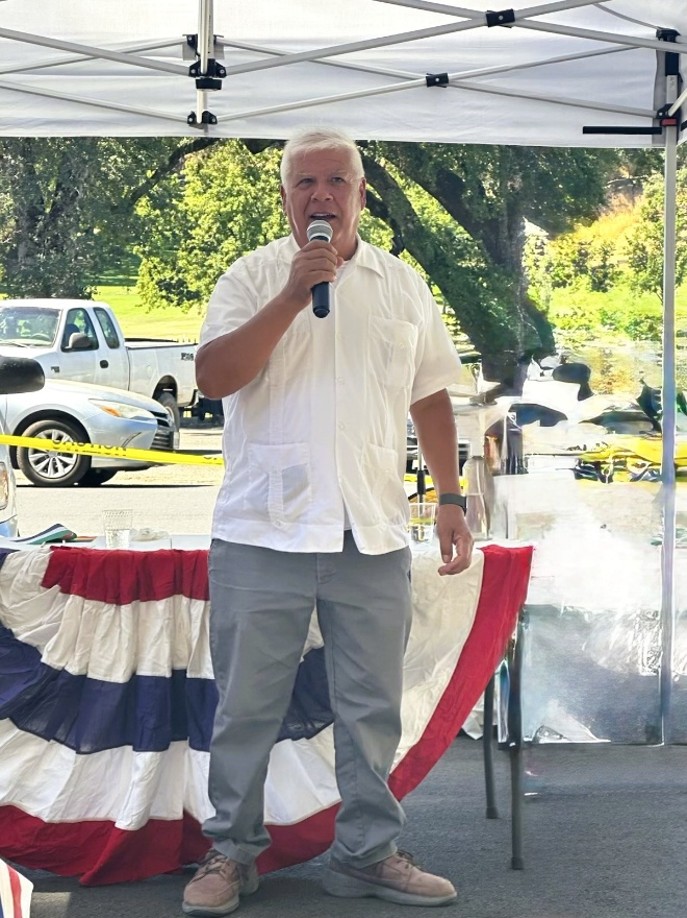
Juan Orozco, Ukiah Vice Mayor
Ukiah's Vice Mayor, Juan Orozco, had watched the project evolve over some years. When the groundbreaking took place, he was struck less by the ceremony than by the speed.
"I was impressed by how quickly they put the first box in the ground at the [groundbreaking] ceremony. Wow, it's not something we're used to. Also, the fact that we have a map to see the extent of the project. That was really good to see." -Juan Orozco, Ukiah Vice Mayor
Biagi recounted how Vero Fiber Networks was originally founded to address a need for high-capacity fiber networks serving school districts and educational institutions across the county, and later they expanded to fiber-to-the-home (FTTH) networks in underserved communities and smaller municipalities where reliable broadband infrastructure is often lacking.
"Our focus has always been on being a true community partner and helping bring better connectivity, competition, and long-term infrastructure investment to markets that have historically been overlooked. What stood out to us about Ukiah was the City’s vision and proactive approach to solving community broadband needs, combined with its efforts to secure funding through the Federal Funding Account program and willingness to leverage existing public infrastructure. We believe these are key ingredients that separate successful broadband initiatives from projects that never get off the ground." -Evan Biagi, Vero Fiber Networks
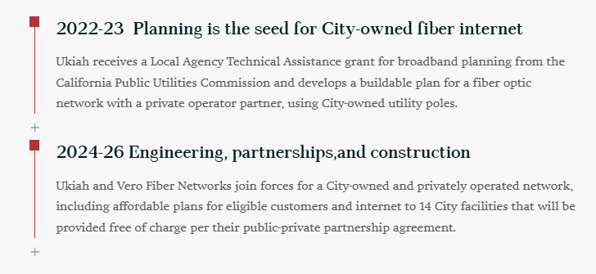
2022-26 Internet installation timeline
A Platform for the Future
Phase two, citywide expansion, is also on the table. Private investment is now possible because the public investment in phase one demonstrates a viable business.
Vero's Evan Biagi explained that they plan to continue investing private capital as the network expands beyond the first phase, to extend fiber access throughout the rest of the City and potentially into neighboring communities that can benefit from the same approach.
The fiber infrastructure opens doors that weren't there before. Among the many possibilities, traffic signals can turn green for fire trucks and emergency routing systems can move faster.
Trincado has been thinking about these applications. The investment in Ukiah means more than a technology upgrade. It is a continuation of the City's commitment to local control, resilience, and community well-being.
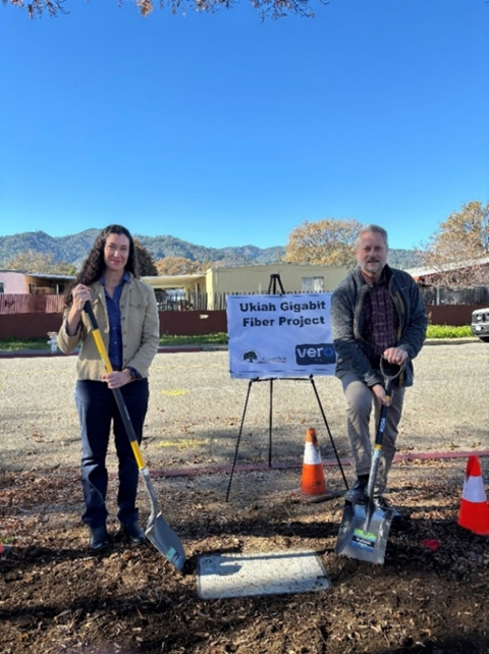
Andrea Trincado and Jim Robbins City of Ukiah
"With smart city infrastructure, emergency vehicles can just turn signals green. There are a lot of other interesting applications that Ukiah can explore for the future to improve safety and quality of life for the community."
Vice Mayor Juan Orozco is looking at the horizon too. Phase one won't connect every signal or sensor, but it establishes the foundation to start thinking about and planning for interconnected city infrastructure through fiber optics.
"It will improve services for our City facilities like our water and wastewater plants, fire department, and our police department. These are critical services for our community. Additionally, fiber will set us up for smart city initiatives." -Juan Orozco, Ukiah Vice Mayor
Ukiah's location and network design, with the fiber backbone along Highway 101, positions it to build future redundancy for wildfire safety and resilience. The public-private broadband model offers something rare in municipal budgeting: predictability. The City knows what the network will cost and what it will generate, year over year. And, Vero Fiber Networks will be responsible for operating and maintaining the system as though it were their own infrastructure. This relieves the City from the cost burden of maintaining the system.
When Jackie Orozco first heard that the City would build its own fiber network, what she felt, she says, was "a sense of peace." The sense that the students and others she advocates for might finally stop being the ones left waiting in the line.
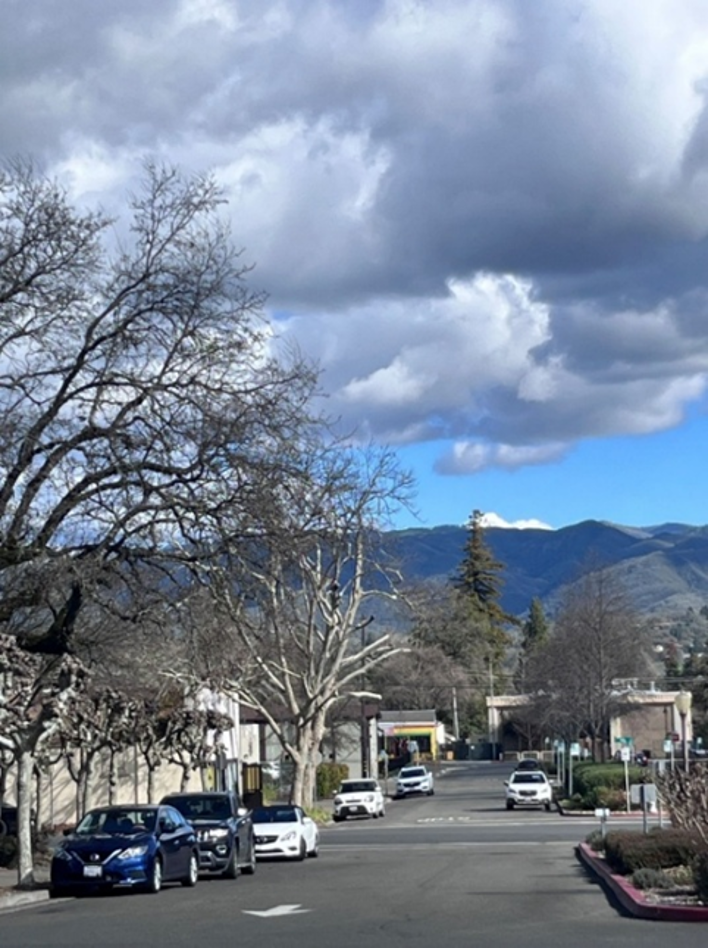
West Standley Street, Ukiah, California (Feb. 2026)
Learn More About Ukiah Gigabit Fiber
Project: UKIAH GIGABIT FIBER
Awardee: City of Ukiah, California
Internet Provider: Vero Fiber Networks
Business Model: Public-Private Partnership
Funding: Up to $5.6 million in Resolution T-17839 (Sept. 2024)
Infrastructure Grant Program: Last Mile Federal Funding Account
Program Map: Federal Funding Account Awards Map
Administered by: California Public Utilities Commission
Project County: Mendocino
Project Size: 3 square miles
Estimated Benefitting Population: 9,100
Maximum Speed: 10 gigabits symmetrical
Technology: Fiber using passive optical network
Lowest Cost Plan: $39.95/month for eligible customers
Connects to: Middle Mile Broadband Network
Planning Grant: Local Agency Technical Assistance

By Michele King (Sr. Policy Analyst) with the CPUC’s Broadband Regional Initiatives team
This story is part of the California Connectivity Stories Project, which highlights rural and urban broadband internet initiatives by local governments, Tribes, open access partnerships, and emerging internet service providers. California invests in essential broadband infrastructure that provides connectivity for daily life, climate resilience, public safety, and more. Featured projects are supported by the California Public Utilities Commission's Last Mile Federal Funding Account established in Senate Bill (SB)156 (2021).
Interactive StoryMap: California Connectivity Stories: City of Ukiah
Contact: Broadband.Caseworkers@cpuc.ca.gov