Expert Insights, Earth Month Edition: Energy Efficiency Leadership of the Past, Reimagined for the Future

Earth Month often brings renewed attention to energy decarbonization in order to support a greener future. Energy efficiency is a tried-and-true sustainability strategy, and nowhere other than California is this better known. California has consistently led the nation on energy efficiency. From early adoption of appliance efficiency standards to pioneering policies like utility decoupling, which separates utility profits from energy sales, California has successfully kept per-capita energy use flat even as its economy has grown. 
Today, California’s energy efficiency efforts span every sector of the economy - residential, commercial, industrial, agricultural, and public. This leadership continues to earn national recognition. In 2025, California ranked #1 for the seventh time on the American Council for an Energy-Efficient Economy State Energy Efficiency Scorecard, earning an impressive 93.5 out of 100.
Building on decades of success, programs of the California Public Utilities Commission (CPUC) are evolving to meet today’s challenges and accelerate the transition to a clean energy future.
Here are a few examples of how the CPUC remains on the cutting edge of energy efficiency:
1. Modernizing Legacy Programs: Energy Savings Assistance
A cornerstone of CPUC efforts is the Energy Savings Assistance (ESA) program, originally designed as a low-income weatherization initiative. Today, it has been reimagined to support whole-home electrification. Rather than simply improving insulation or sealing leaks, ESA now helps households replace fossil fuel appliances with cleaner, electric alternatives. California’s investor-owned utilities now offer whole home electrification pilot programs that help low-income customers transition from natural gas appliances to more efficient electric heat pumps. The programs are helping save customers up to $500 on their energy bills every year and can bring anywhere from 5-50 percent of whole home energy savings.
2. A Smarter Approach for Industry: Strategic Energy Management
Most energy efficiency programs work like this: a utility pays a business to replace an old piece of equipment with a more efficient one, and that's the end of the relationship. The business gets a rebate, the utility claims the kilowatt-hour savings, and everyone moves on. Strategic Energy Management (SEM) is fundamentally different. The SEM program is offered to industrial customers to reduce energy consumption through low- to no-cost operations, maintenance, and behavioral opportunities that can be maintained year over year. Instead of just swapping out equipment, SEM teaches a factory, a farm, or a large commercial building how to manage its energy use the way a good business manages any other operating costs, with goals, data, accountability, and continuous improvement. SEM launched in 2018 and focused on industrial customers like manufacturers, food processors, dairies, and water agencies. The CPUC has since expanded it to non-industrial market sectors including commercial, agriculture, and multifamily.
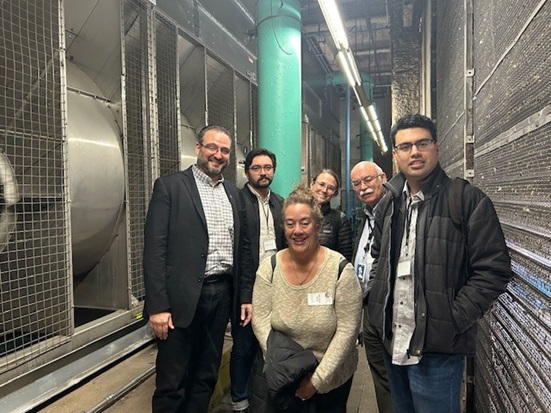
A team from the CPUC on an engineering tour of the San Francisco Marriot Marquis. The team observed the hotel’s SEM practices, including the central plant and thermal storage units.
3. Transforming Markets for the Long-Term
The customer-side energy efficiency programs the CPUC oversees deliver near-term results like cost savings, appliance installations, energy savings, and emissions reductions. But there is a parallel, longer-term effort underway at something more fundamental: changing what gets manufactured, stocked on store shelves, and installed by default across the state. That is the work of the California Market Transformation Administrator (CalMTA), established by the CPUC and funded at approximately $300 million over an eight-year implementation period. The current market transformation initiatives target room heat pumps and induction stoves. Instead of achieving quick energy savings by incentivizing customers or procuring and delivering products directly, the goal of market transformation programs is to work within the market ecosystem to create sustained change to make energy efficient products the norm. These initiatives are ushering in a future where the default choice at the point of purchase is already the efficient, electric option without a rebate program.
The CPUC’s suite of energy efficiency programs work hand-in-hand: the near-term programs create demand and demonstrate feasibility today, while market transformation works to permanently shift the supply chain and consumer expectations so that efficiency no longer requires ongoing intervention to sustain.
Together, the CPUC and energy efficiency program administrators have demonstrated that energy efficiency is one of California's most versatile climate tools, one that delivers health, equity, workforce development, and decarbonization benefits alongside energy savings.
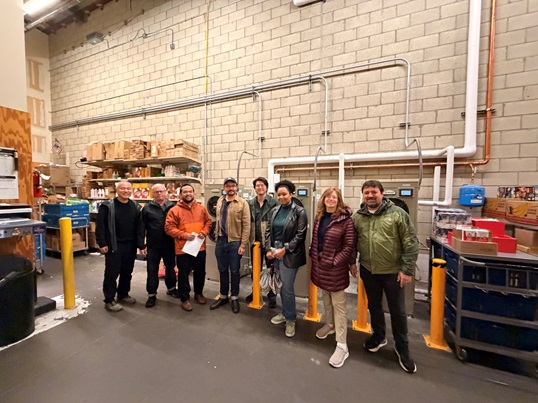
Staff from the CPUC’s Energy Efficiency Branch visiting a large grocery store in Southern California, which has transitioned to energy efficient electric heat pump technology for water heating throughout the building, replacing the previous natural gas-powered system.
By Jeorge Tagnipes, Program Manager with the CPUC’s Energy Efficiency Branch