
Meeting California's Climate Goals: Eliminating Emissions from the Transportation Sector

California’s transportation sector accounts for about 50 percent of the state’s greenhouse gas emissions and a majority of the harmful pollutants in the air we breathe. Transportation emissions predominantly come from gas-powered cars and trucks. Swapping out these “internal combustion engine” or gas-powered, vehicles for electric vehicles (EVs) offers a pathway to not only meet our state climate goals but significantly improve air quality in those communities that have been identified as having extreme levels of pollution. As customers purchase electric vehicles, and companies electrify their truck fleets, what role does the California Public Utilities Commission (CPUC) play?
In 2020, Governor Newsom’s Executive Order N-79-20 established the goal for all in-state sales of new passenger vehicles to be zero-emission by 2035; 100 percent medium- and heavy-duty vehicles to be zero-emission by 2045. A suite of legislation in recent years aimed to ensure that the state builds enough EV charging to meet these goals of zero-emissions car and truck sales. That’s where the CPUC comes in.
“The rise in EV charging needs places greater demands on California’s power grid and requires the state’s electric utilities to prepare for this need,” said Kerry Fleisher, Director of the Office of Distributed Energy Resources, Natural Gas & Retail Energy Rates in the CPUC’s Energy Division. “The CPUC has adopted several key processes to address this, helping to make sure the road to vehicle electrification is smooth.”
Proactive Planning
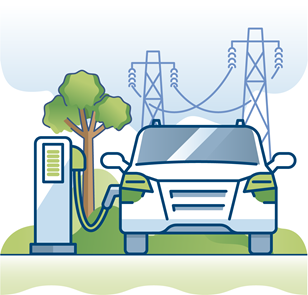
For much of modern life, utilities only had to worry about delivering safe and reliable service to meet the electricity needs of the present. However, to make sure the electricity grid can serve future demand, such as from an influx of EV charging needs in the coming years, we need to proactively plan. This requires coordination between utilities, the CPUC, and the California Energy Commission (CEC).
The CPUC has adopted the CEC’s Integrated Energy Policy Report (IEPR) demand forecast as its requirement for utility planning. The report reflects higher transportation electrification consistent with state policy goals and informs the process of approving utility investments in new grid infrastructure.
Getting Connected
While this forward-looking grid planning imagines future EV charging needs, many vehicle charging service providers are ready to be connected to the grid to deliver a reliable charging network for today’s drivers. Utilities often need to make localized grid upgrades to accommodate these large load customers, a process known as energization. While charging equipment can be delivered and installed in a matter of months, energization may take longer, depending on the upgrades required.
Through its energization Rulemaking proceeding, the CPUC establishes reasonable timelines for energization. In the proceeding, the CPUC already adopted D.02.025, directing utilities to establish a standard offer for “flexible service connections.” This offering for large load customers allows charging stations to begin serving customers at partial capacity while they wait for full energization, agreeing to reduce their capacity during times when the grid is strained.
Helping EVs and the Grid Work Together
In addition to making critical process changes such as adopting the IEPR and establishing flexible service connections, the CPUC is exploring a future where electric vehicles can work with the grid to provide net benefits to ratepayers. “Unlike buildings or industrial energy needs that are stationary and have relatively unchangeable electricity use, EVs can operate more flexibly – think school buses that are only in service in the early mornings and late afternoons, or long-haul trucks that stop to charge along their routes,” said Director Fleisher. “EVs can serve as flexible energy loads, able to optimize charging time, level, or location, to best serve the needs of the grid or work around constraints.”
One mechanism to achieve greater vehicle-to-grid integration is through rate structures specifically designed for demand flexibility, which helps direct energy use to the times most optimal for the grid. In 2025, the CPUC adopted guidelines for utilities to design demand flexibility rates to provide accurate price signals for customers to use electricity, including for electric vehicle charging, when it is most abundant on the grid.
Bringing it all Together
EVs and charging infrastructure present and “chicken and egg” issue. Adequate charging is needed to encourage customers to purchase EVs, however, for utilities to accommodate this infrastructure, they need to plan for the EVs of the future. The current processes adopted by the CPUC help facilitate the reliable planning for this future while making energization of new charging stations a reality today.
This is the third article in the CPUC’s “Meeting California’s Climate Goals Series,” exploring the agency’s role in the statewide transition to a carbon-free economy. We highlight the regulatory levers and programs that help position the state on the least-cost path to net zero emissions across the electric, buildings, transportation, and industrial sectors.
By Liza Martin, Public Information Officer